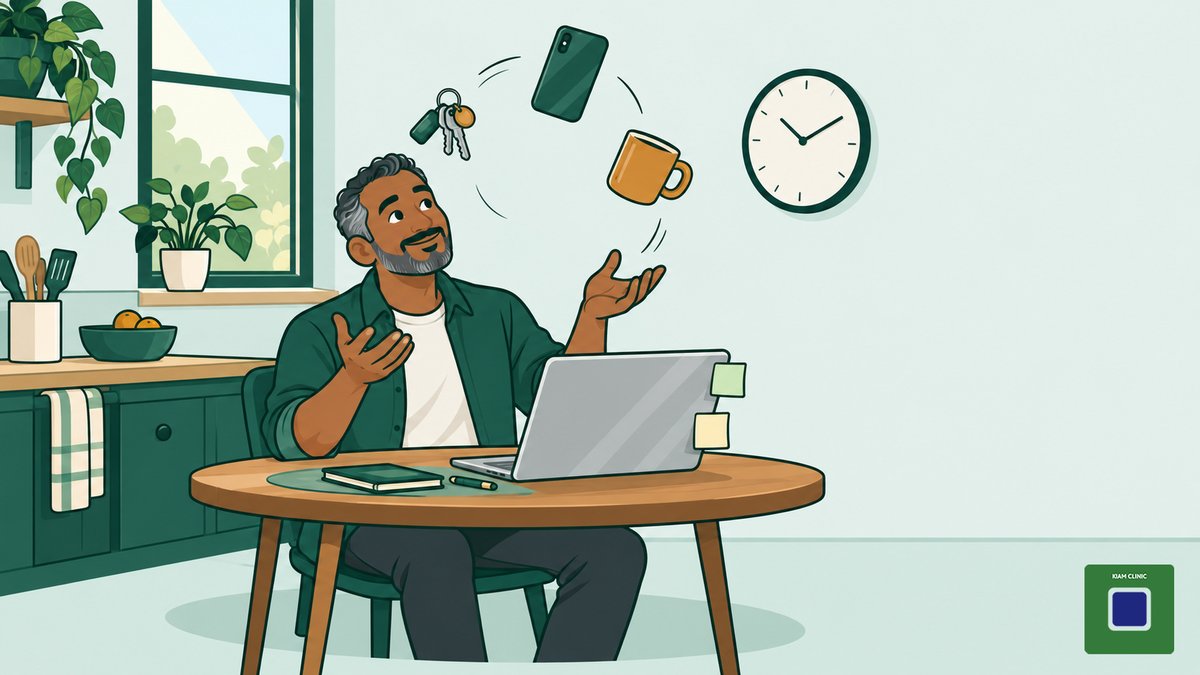
Adult ADHD symptoms fall into three groups: inattention, hyperactivity and impulsivity, as the NHS explains. Day to day, that might mean losing your keys, drifting off in meetings, feeling restless inside or blurting things out.
Most people have moments like these, as the Royal College of Psychiatrists points out. What points towards ADHD is a lasting pattern that started in childhood, shows up in several areas of life and causes real difficulties.
This guide turns those symptoms into everyday examples from work, home and relationships. It isn't a checklist and can't diagnose ADHD, but it may help you decide whether to look more closely.
In short
- Adult ADHD symptoms involve inattention, hyperactivity and impulsivity, and most people with ADHD have a mix.
- In adults, hyperactivity is often an inner restlessness rather than obvious activity.
- ADHD is a lasting pattern that began in childhood and causes problems in several areas of life.
- ADHD can look like, or sit alongside, anxiety or depression.
- A screening test can guide your next step, but only a specialist assessment can diagnose ADHD.
What are the main adult ADHD symptoms?
The main adult ADHD symptoms are long-standing problems with attention, restlessness and acting on impulse. Specialists use two diagnostic manuals, DSM-5 and ICD-11. The NICE guideline on ADHD, which applies in England and Wales, says symptoms must meet the criteria in one of them.
DSM-5 sorts the symptoms into two groups:
- Inattention: finding it hard to focus, get organised, finish tasks or remember things.
- Hyperactivity and impulsivity: feeling restless, talking a lot, interrupting and acting before thinking.
Most people with ADHD have symptoms from both groups, while some mainly have one. The Royal College of Psychiatrists says ADHD affects about 3 to 4 in every 100 adults.
Symptoms also change with age. In adulthood, inattention often becomes more of an issue. Hyperactivity can turn into what a European consensus of adult ADHD experts describes as inner restlessness: a busy mind, or finding it hard to relax.
What can ADHD look like at work or study?
At work or college, ADHD often shows up as uneven focus. Routine tasks can feel much harder than they should, while urgent or interesting ones may feel easier. For example, you might:
- miss small details in emails or reports, even in work you know well;
- drift off in long meetings, or reread the same page;
- start projects with energy, then leave them half-finished;
- put off long, dull tasks such as expenses or revision;
- underestimate how long things take, and often run late.
The Royal College of Psychiatrists says some people with ADHD also notice strengths. These include creativity, doing well in a crisis, and hyperfocus: intense focus on something that really interests you. It's one reason the comment "but you can concentrate when you want to" can feel so unfair.
Our ADHD resources page links to guidance on adjustments at work and in education.
What can ADHD look like at home?
At home, ADHD symptoms often show up in the everyday admin of life: keys, bills, chores and routines. You might notice:
- losing things such as your phone, wallet, keys or paperwork, again and again;
- forgetting appointments, birthdays or bill payments;
- starting several chores and finishing none of them;
- impulse buys that later cause money worries;
- no settled routine, such as a bedtime that keeps slipping later.
Some adults cope well for years with plenty of structure around them. The Royal College of Psychiatrists notes that ADHD may only start to cause problems after leaving home, when that support falls away.
How can ADHD show up in relationships?
In relationships, ADHD symptoms can cause friction, often around listening, remembering and emotions. For example, you might:
- lose the thread while someone is talking to you;
- interrupt, or answer before someone has finished their question;
- talk a lot, or jump from one topic to another;
- forget plans or promises, even ones that matter to you;
- feel a flash of frustration or anger that fades as quickly as it came.
The European consensus describes quick emotional ups and downs as a recognised feature of adult ADHD. They tend to be short reactions to everyday events, unlike the longer-lasting changes in mood seen in depression.
What can ADHD feel like on the inside?
Many adults with ADHD describe a busy, restless mind that other people can't see. It might feel like:
- a mind that won't settle, with thoughts jumping from one topic to the next;
- hidden effort, working hard to cover up your difficulties, which can be exhausting;
- low self-esteem, after years of feeling you should be doing better.
Because so much happens on the inside, sitting calmly through an appointment does not rule ADHD out, as the European consensus points out.
How is ADHD different from everyday forgetfulness?
The difference is the pattern: ADHD symptoms go back to childhood, show up in more than one setting and cause real problems. NICE says ADHD should only be diagnosed by a trained specialist, after a full assessment. Using NICE guidance and DSM-5, the specialist checks that symptoms:
- started early, with several before the age of 12, even if nobody noticed at the time;
- show up in at least two settings, such as work, home or social life;
- cause at least moderate difficulties, not just the odd bad day;
- aren't better explained by something else, such as another mental health condition.
ADHD is recognised less often in women, possibly because women more often have inattentive symptoms, which can be harder to spot.
If you're reading this with a child in mind, signs in children can look different. Our assessment for children and young people is led by a Consultant Child and Adolescent Psychiatrist.
Frequently asked questions
Can ADHD start in adulthood?
ADHD starts in childhood, but for some people it isn't recognised until adulthood. The NHS says symptoms usually start before the age of 12.
Difficulties often become clearer when life gets more demanding. That's why a specialist will ask about your childhood, and may speak to someone who knew you then.
Is there an ADHD symptoms checklist for adults?
Not one that can diagnose ADHD. Specialists work from the symptom lists in DSM-5 or ICD-11, but NICE guidance says a diagnosis should never rest on a rating scale or checklist alone.
A screening questionnaire can suggest whether an assessment is worth considering. Only a full clinical assessment can confirm or rule out ADHD.
What signs of ADHD in adults do other people notice?
Friends, family and colleagues may notice things you have simply learned to live with. The Royal College of Psychiatrists lists signs such as missed appointments, unfinished projects, uneven work performance, money difficulties and relationship strain.
None of these means ADHD on its own. A long-standing mix of them may be worth discussing with a professional.
Can ADHD symptoms look like anxiety or depression?
Sometimes. NICE notes that ADHD symptoms can overlap with those of other conditions, and the NHS says anxiety and depression often occur alongside ADHD.
ADHD can also be missed when another diagnosis explains only part of someone's difficulties. A careful assessment looks at your mental health as a whole.
When to get help
It's worth getting a professional view if these difficulties are affecting your work, studies, relationships or wellbeing. It may be especially worth asking if:
- the pattern goes back to your school days, even if nobody named it;
- strategies that used to work are no longer enough;
- a child or close relative has been diagnosed with ADHD, as it often runs in families.
Your GP can talk through your symptoms and may refer you to an ADHD specialist. If your mood is low or you feel unsafe, please speak to your GP, or use the urgent contacts below.
If this sounds familiar, you could talk to your GP or book an adult ADHD assessment with one of our consultant psychiatrists, online or at our Epsom clinic. Only a full assessment can tell you whether ADHD is the explanation.
Recognising yourself in some of these examples doesn't mean you have ADHD, and finding these things hard is not a personal failing. Whatever you decide, our team is happy to answer your questions.
Need help now? If you think you might act on thoughts of suicide or you are in danger, call 999 or go to A&E. For urgent mental health help, call NHS 111 and choose the mental health option. You can talk to Samaritans any time, free, on 116 123, or text SHOUT to 85258.
Related reading
- What Actually Happens in an Adult ADHD Assessment?: what to expect, step by step, if you decide to be assessed.
References
- ADHD in adults. NHS, 2025.
- ADHD in adults. Royal College of Psychiatrists, 2023.
- Attention deficit hyperactivity disorder: diagnosis and management (NG87). NICE, 2018, updated 2019.
- Updated European Consensus Statement on diagnosis and treatment of adult ADHD. Kooij JJS and others, European Psychiatry, 2019.
Useful resources
- ADHD UK: a UK charity offering information, online support groups, and guidance on ADHD at work and in education.
- Access to Work (GOV.UK): a government scheme that can help pay for practical support at work if you have a physical or mental health condition or disability.
This article is for general information. It is not a diagnosis or a substitute for advice from a qualified professional who knows your situation.