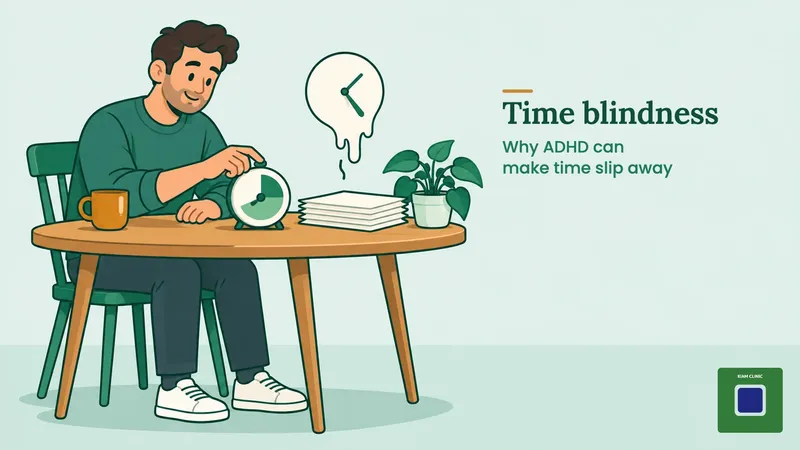
Time blindness is a common part of adult ADHD: a weaker sense of how much time has passed, or how long something will take. It happens because ADHD affects attention, planning and self-monitoring, not because of a lack of effort or care.
If "I'll just be five minutes" reliably turns into twenty-five, you're not imagining it. Research suggests the brain often judges time differently in ADHD, and it's one pattern a specialist looks for in a full assessment.
In short
- Time blindness means time is hard to sense passing, not that you don't care about being on time.
- It's linked to how ADHD affects attention, planning and the brain's internal sense of time.
- It can show up as running late, misjudging how long tasks take, or losing hours to hyperfocus.
- Making time visible and audible tends to help more than simply trying harder.
- A specialist assessment can look at this alongside other ADHD symptoms.
What is time blindness, and why does ADHD cause it?
Time blindness is a difficulty sensing the passage of time accurately: how long ten minutes actually feels, or how much of a task is really left. It isn't a diagnosis on its own, but a pattern linked to the wider attention and planning difficulties in ADHD, sometimes grouped under "executive function": the mental skills that let us plan, start, switch between and finish tasks.
A 2023 review of research on time perception in adult ADHD found people with ADHD often show measurable differences in judging and reproducing time intervals, though study size and methods vary, so not every finding is settled. What's consistent is that this sits alongside, and likely shares a cause with, the same attention and planning difficulties seen elsewhere in ADHD.
What does time blindness feel like day to day?
Time blindness can look different from person to person, but common patterns include:
- Chronic lateness, despite genuinely meaning to be on time and often planning to leave "early".
- Underestimating how long things take: a ten-minute job that quietly becomes forty.
- Losing hours to hyperfocus: sitting down to one email or task and looking up two hours later.
- "Waiting mode": struggling to start anything else because something is happening later, even hours away.
- Deadlines that seem to appear suddenly, even when you knew the date all along.
None of this means someone doesn't value other people's time. It means their internal sense of time is a less reliable guide than most people's.
Why can't you just try harder?
Trying harder assumes the problem is motivation, and usually it isn't. The NHS lists finding it hard to organise your time as a recognised symptom of ADHD in adults, alongside distractibility and difficulty finishing tasks. NICE's guideline on ADHD recognises that these difficulties affect daily life across school, work and relationships, and recommends practical, environmental changes alongside any other treatment, not just willpower.
That reframing matters. Blame tends to make people mask the problem rather than solve it, which is tiring and rarely works for long.
What helps with time blindness?
Most effective strategies work by making time visible or audible, rather than relying on an internal sense of it:
- Keep time in view. An analogue clock or a visual timer in the room you're working in makes time something you can see, not just remember.
- Set more than one alarm. One reminder is rarely enough; try an earlier warning and a "leave now" alert for anything time-sensitive.
- Time-block with a buffer. Give tasks a set slot, and add ten to fifteen minutes either side, since switching tasks takes longer than it feels like it should.
- Work alongside someone. Some people find it easier to start and finish a task with someone quietly working nearby, in person or on a call.
- Keep essentials in one place. Keys, travel card and bag in one spot cuts the last-minute searching that eats into time.
Our ADHD resources page links to further practical tools for daily life with ADHD.
Does support from a professional make a difference?
For many people, practical strategies plus professional support work better than either alone. Dr Nazee Akbari, our accredited psychotherapist, offers ADHD coaching and therapy that builds practical systems for planning and following through, alongside the toll of years of feeling like you're always running behind.
NICE's guideline also recognises medical treatment, where clinically appropriate, as part of ADHD care alongside psychological and practical support. What's right varies person to person, which is what a specialist assessment works out with you.
Frequently asked questions
Is time blindness an official ADHD diagnosis?
No. Time blindness isn't a diagnosis on its own; it's a term for a common experience linked to ADHD's effect on attention and planning. A clinician assessing you for ADHD looks at your whole pattern of symptoms, of which difficulty with time is often one part, not the whole picture.
Can time blindness happen without ADHD?
Yes. Tiredness, stress, depression and other conditions can all affect concentration and your sense of time. What tends to point towards ADHD is a long-standing pattern, present since childhood, showing up across more than one area of life, such as work, home and relationships.
Do visual timers really help?
Many people find them genuinely useful, because they turn an abstract sense of time into something you can see or hear, rather than hold in mind. They're a simple, low-cost strategy worth trying, though what works best varies from person to person.
Can I be assessed for ADHD if time blindness is my main problem?
Yes. An assessment looks at your whole pattern of attention, planning and behaviour, not a single symptom alone. If time blindness is a significant, lasting difficulty, it's worth raising as part of a fuller conversation with a specialist about whether ADHD explains what you're experiencing.
When to get help
It's worth getting a professional view if problems with time are long-standing, started in childhood, and are causing real difficulties at work, at home or in relationships, especially alongside other signs such as restlessness, disorganisation or trouble finishing tasks.
If this sounds familiar, you could talk to your GP or book an assessment with one of our consultant psychiatrists, online or at our Epsom clinic. Only a full assessment can tell you whether ADHD is the explanation.
Struggling with time doesn't mean you're careless, and it isn't something you have to manage on your own. With the right understanding and support, many people find that time stops feeling like something that's constantly working against them.
Related reading
- Adult ADHD symptoms: what they can look like day to day — for the wider picture of how ADHD can show up across work, home and relationships.
References
- Time Perception in Adult ADHD: Findings from a Decade—A Review. Christian Mette, International Journal of Environmental Research and Public Health, 2023.
- Attention deficit hyperactivity disorder: diagnosis and management. NICE, 2018, updated 2019.
- ADHD in adults. NHS, current guidance.
Useful resources
- ADHD UK — a national charity offering information, community and support for adults and families affected by ADHD.
- AADD-UK — a UK charity run by and for adults with ADHD, with information and local support groups.
This article is for general information. It is not a diagnosis or a substitute for advice from a qualified professional who knows your situation.