ADHD can affect relationships in everyday ways: forgetting plans, losing track of time, interrupting, or making quick decisions without talking them through. A partner may read these as not caring, and frustration can build on both sides, but understanding ADHD together and getting the right support can make a real difference.
ADHD (attention deficit hyperactivity disorder) affects attention, activity levels and impulse control. Knowing how it shows up at home can help couples stop blaming each other and solve problems as a team.
In short
- ADHD symptoms such as forgetfulness and impulsivity can cause friction between partners.
- Research suggests relationships can be harder on average when one partner has ADHD, but this is not true of every couple.
- Partners can learn about ADHD, join support groups and look after their own wellbeing.
- Therapy, coaching and treatment can help with the skills that strain relationships.
How can ADHD affect a relationship?
The NHS guide to ADHD in adults lists signs that can easily cause friction at home:
- being easily distracted or forgetful;
- finding it hard to organise time, so plans run late;
- losing things often;
- being very talkative or interrupting conversations;
- making quick decisions without thinking about what might happen.
A 2021 review of research on adult ADHD and romantic relationships found that, on average, adults with ADHD tend to have shorter and more strained relationships. The authors also note that little research has looked at what helps couples, so there is still a lot to learn. An average is not a prediction for any one couple.
Why can ADHD symptoms feel personal?
ADHD is not visible, so its effects are easy to mistake for personality or a lack of effort. Someone might forget an anniversary because they lost track of the date, not because it didn't matter, but their partner may still feel hurt.
Over time, one partner may take on more of the planning and reminders. Some couples find this leaves one feeling like a nag and the other feeling criticised. Naming the pattern together, without blame, can be a first step to changing it.
What can help if you have ADHD?
- Tell your partner what helps. The Royal College of Psychiatrists suggests telling the people in your life what you do and don't find helpful.
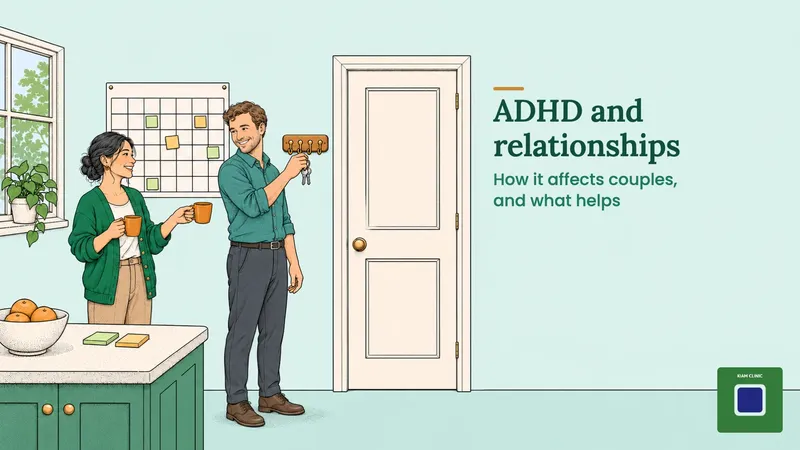
- Make plans visible. Some couples use a shared calendar, phone reminders or a whiteboard for jobs and dates.
- Look after the basics. The College notes that poor sleep can make ADHD symptoms worse, and that regular exercise can help with symptoms of anxiety and low mood.
The College also says cognitive behavioural therapy (CBT) can help with emotional regulation, time management and understanding other people's perspectives, all of which can ease tension at home.
What can help if your partner has ADHD?
Supporting a partner with ADHD works better when you look after yourself too. The Royal College of Psychiatrists suggests:
- Learn about ADHD. It looks different from person to person.
- Ask what helps. Ask your partner if there is anything you can do.
- Find support. Some adult ADHD peer support groups run groups for partners or welcome them to the main group.
- Manage your frustrations. Talk your feelings through with someone you trust. When you raise a problem, explain clearly what the issue is and what might help.
NICE guidance on ADHD says family members should be encouraged to seek an assessment of their own personal, social and mental health needs, and to join support groups if that would help.
Can assessment and treatment help a relationship?
They can. NICE says that after a diagnosis, the specialist should talk with the person about how ADHD could affect their life, including their relationships. Adults can also choose to bring a partner into discussions about treatment.
Treatment is agreed with each person after a full assessment. Our ADHD coaching and therapy includes CBT, dialectical behaviour therapy (DBT) and mindfulness-based approaches, alongside practical coaching for organisation and time management.
Frequently asked questions
Can ADHD cause relationship problems?
ADHD can contribute to relationship problems, but it doesn't cause them on its own. Symptoms such as forgetfulness, distraction and acting on impulse can lead to misunderstandings and frustration. Research suggests relationships can be harder on average when one partner has ADHD. Many couples find these become easier to manage with understanding and support.
Should I tell my partner I have ADHD?
That is your choice. Many people find that explaining their diagnosis helps a partner understand behaviour they may have taken personally. The Royal College of Psychiatrists suggests telling the people in your life what you do and don't find helpful, because people often want to help but don't know how.
Can my partner come to my ADHD appointments?
Often, yes. NICE guidance says adults with ADHD should be asked whether they would like a partner, close friend or carer to join discussions about treatment. During an assessment, the NHS notes that the specialist may want to speak to someone who knows you well, such as a family member or close friend.
How can I tell if my partner might have ADHD?
You can't diagnose a partner, but some patterns are worth noticing. The Royal College of Psychiatrists lists signs friends and family might spot, including problems organising time, missed appointments, difficulty managing money, a lack of routine, and family or relationship problems. If these cause real difficulties, gently suggest they talk to their GP.
When to get help
It may be worth getting professional support if:
- ADHD symptoms are causing regular arguments or distance between you;
- either of you is feeling stressed, low or overwhelmed;
- you think you or your partner might have ADHD that has never been assessed.
The NHS advises seeing a GP if ADHD symptoms are affecting your relationships. If you already have a diagnosis, Dr Nazee Akbari, our Accredited Psychotherapist, supports adults with how ADHD affects their relationships, work and emotional wellbeing, in English and Farsi/Dari.
If you haven't been assessed, our free five-minute ADHD self-screening test can't diagnose ADHD, but it can help you decide whether to book an adult ADHD assessment with one of our consultant psychiatrists, online or at our Epsom clinic.
ADHD is one part of a relationship, not the whole story, and many couples learn to work with it together.
Need help now? If you think you might act on thoughts of suicide or you are in danger, call 999 or go to A&E. For urgent mental health help, call NHS 111 and choose the mental health option. You can talk to Samaritans any time, free, on 116 123, or text SHOUT to 85258.
Related reading
- Adult ADHD symptoms: what they can look like day to day: how ADHD shows up in daily life.
- Time blindness: why ADHD can make time slip away: why lateness happens, and what helps.
References
- Attention deficit hyperactivity disorder (ADHD) in adults. NHS, 2025.
- ADHD in adults. Royal College of Psychiatrists, 2023.
- Adult ADHD and romantic relationships: what we know and what we can do to help. Wymbs BT et al., Journal of Marital and Family Therapy, 2021.
- Attention deficit hyperactivity disorder: diagnosis and management (NG87), Recommendations. NICE, 2018, updated 2019.
Useful resources
- ADHD UK: a charity offering information, support groups and guidance for adults with ADHD and the people close to them.
- AADD-UK: a charity for adults with ADHD, with links to local peer support groups.
- Relate: the UK's relationship support charity, offering counselling for couples and individuals.
This article is for general information. It is not a diagnosis or a substitute for advice from a qualified professional who knows your situation.