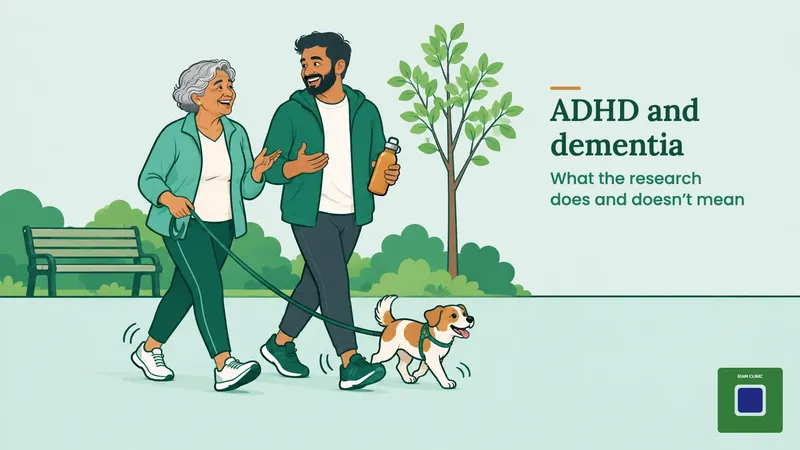
Research suggests that adults with ADHD may be more likely than other adults to be diagnosed with dementia later in life. But this is a link, not proof that ADHD causes dementia, and most people with ADHD will never develop it.
A 2025 review in Frontiers in Dementia, by Angel Golimstok and Waleska Berrios, pulls together the long-term studies on ADHD and dementia so far. Here is what it found, what it can't tell us, and what you can do today.
In short
- Several large studies have linked adult ADHD with a higher chance of dementia in later life.
- These studies show a link, not a cause.
- In the biggest long-term study, most older adults with ADHD did not develop dementia.
- Conditions that often come with ADHD, such as depression, may explain part of the link.
- The NHS's advice on lowering dementia risk applies to everyone.
What does the research on ADHD and dementia say?
Long-term studies have found that adults with ADHD are diagnosed with dementia more often, and the review suggests the link may be strongest for less common types where memory loss is not the main early sign, such as Lewy body dementia.
The largest study it discusses followed more than 109,000 adults in Israel, aged 51 to 70 at the start, for up to 17 years. By the end:
- about 13 in 100 people diagnosed with ADHD as adults had a dementia diagnosis;
- about 7 in 100 people without ADHD did.
The link held after allowing for 18 other factors. A Swedish study of 3.6 million people also found a link, but it became much weaker once other mental health conditions were taken into account.
Does ADHD cause dementia?
We don't know. A 2023 systematic review, which searched for every relevant study in a set way, found seven. They point to a link, but the size of ADHD's own effect, and the reason for it, are unclear.
Researchers have several ideas, none of them proven:
- Brain chemistry: ADHD involves differences in dopamine, a chemical messenger, and some dementias involve losing dopamine-producing cells, though these are different processes.
- Other conditions: depression, anxiety, sleep problems and substance use are common alongside ADHD, and each is linked with dementia.
- Heart health and lifestyle: inactivity, a poor diet and circulation problems may add to the risk.
- Cognitive reserve: the brain's ability to keep working well despite damage. The authors suggest ADHD might lower it, but this has not been tested directly.
What this research can and can't tell us
- Type of study: a short narrative review. The authors chose studies for their relevance, not through a fixed search, so it is an overview rather than a full count of the evidence.
- Who was studied: no new people. It draws on studies from 2009 to 2025, including the Israeli and Swedish ones.
- Its limits: the studies are observational, diagnoses come from health records that can be wrong or missing, and the biological explanations are still ideas to test. One study it reviews came from the lead author's own group.
- Funding and conflicts: none declared.
Neither review says ADHD is a cause, and the NHS does not list ADHD among its dementia risk factors.
What about ADHD medication?
The review also discusses ADHD medication. That evidence is early and observational, so it cannot show whether treatment changes dementia risk, and the authors say trials are needed. If you have questions about your treatment, talk to your prescriber, and don't change anything because of this research.
Should I worry about my memory if I have ADHD?
Not because of this research alone. Being forgetful and losing things are common ADHD symptoms, usually present since before the age of 12. Stress and tiredness can affect memory too.
What matters is change. Dementia is not a natural part of ageing, and the NHS advises seeing a GP if you are becoming more and more forgetful, especially over 65.
How can I lower my risk of dementia?
By following the NHS advice for everyone. There is no certain way to prevent all dementia, but the NHS says a healthy lifestyle can help, and that changing the risk factors we can change could prevent around 4 in 10 cases.
- Move more: at least 150 minutes of moderate activity a week, and sit less.
- Look after your heart: healthy blood pressure, weight and diet.
- Alcohol and smoking: 14 units a week at most, and stop smoking.
- Low mood: get help, because untreated depression is linked with a higher risk.
- Stay connected: loneliness and hearing loss are on the NHS's list too.
If you already have an ADHD diagnosis, your ADHD follow-up appointments are a good place to raise questions about memory, mood or sleep.
Frequently asked questions
Does having ADHD mean I will get dementia?
No. In the largest long-term study, about 87 in 100 older adults with an ADHD diagnosis had not been diagnosed with dementia after up to 17 years. ADHD is linked with a higher chance, but a risk factor is not a prediction. Age, genes, heart health and lifestyle all play a part, and some of those can be changed.
Can ADHD be mistaken for dementia?
The two can look similar, because both can affect attention, memory and organisation. A key difference is timing. ADHD symptoms usually start in childhood, while dementia is an ongoing decline from how someone used to be, and usually gets worse over time. If your memory is getting worse, see your GP, who can look into the cause.
Can older adults have ADHD?
Yes. ADHD often continues into adulthood, and the 2025 review notes research showing that symptoms, especially inattention, can still be present after 50. The Israeli study's authors suggest watching for ADHD in older age. An assessment looks at lifelong patterns, not just recent changes, so it can help at any adult age.
When to get help
It is worth getting a professional view if:
- you are becoming more forgetful, or memory problems affect daily life (see your GP);
- difficulties with attention, organisation or restlessness go back to childhood;
If this sounds familiar, our free five-minute ADHD self-screening test is a good first step. It can't diagnose ADHD, but it can help you decide whether to book an adult ADHD assessment with one of our consultant psychiatrists, online or at our Epsom clinic. If low mood is the main worry, we also offer depression assessment and treatment for adults.
Research like this is a reason to look after your health, not to fear the future.
Need help now? If you think you might act on thoughts of suicide or you are in danger, call 999 or go to A&E. For urgent mental health help, call NHS 111 and choose the mental health option. You can talk to Samaritans any time, free, on 116 123, or text SHOUT to 85258.
Related reading
- Adult ADHD symptoms: what they can look like day to day: how forgetfulness and other everyday ADHD symptoms tend to show up.
- ADHD or stress? How to tell the difference: telling lifelong ADHD apart from problems caused by pressure.
References
- Adult ADHD as a risk factor for dementia: integrating longitudinal evidence, mechanistic insights, and the role of stimulant treatment. Golimstok A, Berrios W. Frontiers in Dementia, 2025. Licence: CC BY 4.0.
- Adult attention-deficit/hyperactivity disorder and the risk of dementia. Levine SZ and others. JAMA Network Open, 2023.
- Risk of neurodegenerative disease or dementia in adults with attention-deficit/hyperactivity disorder: a systematic review. Becker S and others. Frontiers in Psychiatry, 2023.
- ADHD in adults. NHS, 2025.
- What is dementia? NHS, 2023.
- Can dementia be prevented? NHS, 2023.
Useful resources
- Alzheimer's Society: reduce your risk of dementia: practical brain-health guidance from a UK dementia charity.
- NHS Health Check: a free check-up every 5 years for eligible adults aged 40 to 74 in England, which looks for health problems linked with dementia.
- ADHD UK: a charity offering information and support about ADHD for adults and families.
This article is for general information. It is not a diagnosis or a substitute for advice from a qualified professional who knows your situation.