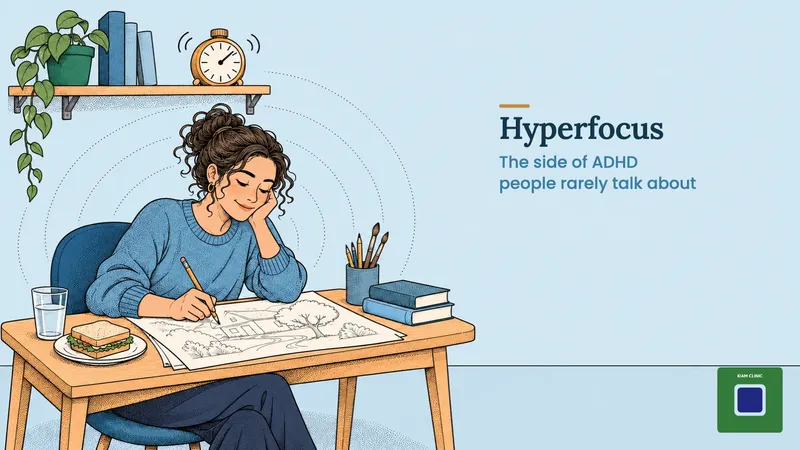
Hyperfocus is a state of deep, absorbed attention on one thing, so complete that time and the world around you seem to fade. Many people with ADHD experience it, which surprises anyone who thinks ADHD only means struggling to concentrate.
ADHD hyperfocus can be a real strength. It can also mean missed meals, late nights and forgotten plans. Here is what it is, why it happens, and how to make it work for you.
In short
- Hyperfocus is intense focus on one task, often with less awareness of time and surroundings.
- Many adults with ADHD report it, but it is not one of the symptoms used to diagnose ADHD.
- It tends to happen with tasks that feel interesting or rewarding, not dull ones.
- It can help you get a lot done, but it can also crowd out meals, sleep and plans.
- Deciding how you will stop, before you start, is often the key to managing it.
What is hyperfocus?
Hyperfocus is complete absorption in a task. A review of research on hyperfocus describes intense, sustained attention, with much less notice of anything unrelated to the task. People often say they "tune out" everything else and lose track of time.
There is no agreed definition yet, and it has been studied very little. The review suggests hyperfocus may be the same thing as "flow", the feeling of being "in the zone".
For example, someone might sit down to fix one cell in a spreadsheet and look up three hours later, having redesigned the whole thing.
Is hyperfocus an ADHD symptom?
Not officially. Hyperfocus is not among the symptoms doctors use to diagnose ADHD, but many people with ADHD describe it.
- A 2019 study of over 600 adults found that people with more ADHD symptoms reported hyperfocus more often: in study, in hobbies and during screen time.
- A 2020 study found that hyperfocus is not specific to ADHD. Adults with a diagnosis reported it about as often as similar adults without one.
Most people have felt something like it. What people with ADHD often describe is the contrast: deep focus on some things, and real difficulty focusing on others.
Why can people with ADHD focus so hard on some things?
Interest seems to make the difference. The Royal College of Psychiatrists says some people with ADHD can "hyper-focus" on things they are interested in, especially when they feel motivated and passionate.
The NHS describes ADHD as a condition that can affect how you focus. Dull tasks, such as paperwork, can be hard to start or finish. Yet once something grabs you, it can be just as hard to leave. Researchers describe people who know what they are ignoring but "cannot give up what they are doing".
What are the upsides of hyperfocus?
Hyperfocus can be a genuine strength. The Royal College of Psychiatrists lists it among the strengths some people with ADHD notice. It can mean:
- Deep knowledge of topics that fascinate you.
- Bursts of high productivity when you feel motivated.
- Staying with a task for much longer than usual.
What are the downsides?
The same focus that helps can crowd out everything else. Researchers note that people in hyperfocus tend to neglect things outside what they are focused on. For example, that might look like:
- skipping meals or drinks without noticing;
- staying up far later than planned;
- missing appointments, messages or the school run;
- leaving a more urgent task untouched.
How can you manage hyperfocus?
The aim is not to stop hyperfocus, but to choose when it happens and how you come out of it. NICE guidance on ADHD calls this kind of change an "environmental modification": changing your surroundings to reduce the effect of ADHD on daily life. Some people find these help:
- Plan your exit before you start. Decide when you will stop and what comes next.
- Use alarms you have to get up for. Put a timer across the room, not on the screen in front of you.
- Leave yourself a note. Write down where you stopped, so leaving feels less like losing your place.
- Look after the basics first. Eat, have a drink and check your diary before you dive in.
- Point it at what matters. Save absorbing work for times when you have a clear stretch.
Coaching can help you build these habits. The Royal College of Psychiatrists says coaches can help with daily life skills such as time management. At Kiam, Dr Nazee Akbari, our accredited psychotherapist, offers ADHD coaching and therapy in English and Farsi/Dari.
Frequently asked questions
What does hyperfocus feel like?
People often describe being so absorbed in a task that everything else fades away. You might not hear someone calling your name, notice that you are hungry, or realise that hours have passed. Researchers describe it as intense, sustained attention with less awareness of time and surroundings. Many people say it feels a lot like being "in the zone".
Is hyperfocus a sign of ADHD?
Not on its own. Hyperfocus is not one of the symptoms used to diagnose ADHD, and people without ADHD experience it too. A diagnosis depends on a pattern of inattention, hyperactivity or impulsivity that started in childhood and causes difficulties in two or more areas of life. Only a full assessment by a specialist can tell whether ADHD is the explanation.
Do children hyperfocus too?
Yes. A research review gives the example of a child so engrossed in a video game that they do not hear a parent calling their name. On its own, this is common and not a sign of ADHD. It is worth a closer look only alongside other difficulties with attention, activity or impulses at home and at school.
When to get help
It may be worth a professional view if:
- you can focus intensely on some things but struggle to start or finish most others;
- hyperfocus often leads to missed meals, sleep, work or family plans;
- difficulties with attention or organisation go back to childhood and affect home, work and relationships.
If this sounds familiar, our free five-minute ADHD self-screening test is a good first step. It can't diagnose ADHD, but it can help you decide whether to book an assessment with one of our consultant psychiatrists, online or at our Epsom clinic. You can see all our ADHD services for children and adults in one place.
If you are worried about your child, talk to the school's SENCo and your GP. We also offer a child ADHD assessment with a Consultant Child and Adolescent Psychiatrist.
Hyperfocus is nothing to fight. With a little structure, it can become one of your most useful tools.
Related reading
- Adult ADHD symptoms: what they can look like day to day: how ADHD shows up day to day, including its strengths.
- ADHD myths: 8 common beliefs and the facts: why "you can concentrate when you want to" misunderstands ADHD.
References
- Hyperfocus: the forgotten frontier of attention. Ashinoff BK, Abu-Akel A. Psychological Research, 2021.
- Living "in the zone": hyperfocus in adult ADHD. Hupfeld KE, Abagis TR, Shah P. ADHD Attention Deficit and Hyperactivity Disorders, 2019.
- Testing the relation between ADHD and hyperfocus experiences. Groen Y and others. Research in Developmental Disabilities, 2020.
- ADHD in adults. Royal College of Psychiatrists, 2023.
- Attention deficit hyperactivity disorder (ADHD) in adults. NHS, 2025.
- Attention deficit hyperactivity disorder: diagnosis and management (NG87), Recommendations. NICE, 2018, updated 2019.
Useful resources
- ADHD UK: a charity offering information and support about ADHD for adults and families.
- AADD-UK: a charity for adults with ADHD, with links to local support groups.
- NHS: ADHD in adults: symptoms, how to get help, and things you can do to manage ADHD.
This article is for general information. It is not a diagnosis or a substitute for advice from a qualified professional who knows your situation.