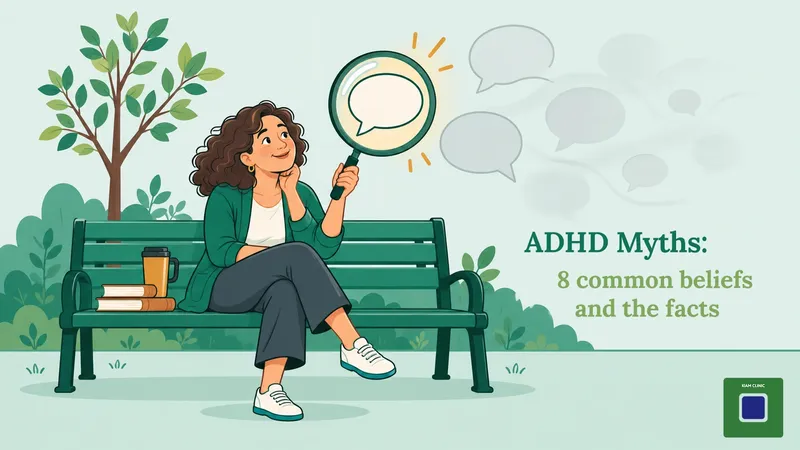
ADHD myths are common: that it isn't real, that only boys have it, or that children grow out of it. The evidence says otherwise. ADHD is a recognised neurodevelopmental condition, one that affects how the brain develops, in children and adults alike.
October is ADHD Awareness Month, a good time to check common beliefs against the research. Here are eight myths, and what is actually true.
In short
- ADHD is a valid diagnosis, recognised around the world.
- It affects girls and women as well as boys and men, and for most people it continues into adulthood.
- Being able to focus on things you enjoy does not rule ADHD out.
- ADHD is not caused by bad parenting or by eating sugar.
- Only a specialist assessment can tell whether ADHD explains someone's difficulties.
Is ADHD real? Two ADHD myths about the diagnosis
Yes. ADHD is a real, well-studied condition, not a modern fashion.
Myth 1: "ADHD is made up, or just a trend"
The Royal College of Psychiatrists says a doctor first described a condition resembling ADHD in the 18th century.
An international consensus statement from the World Federation of ADHD gathered the evidence into 208 conclusions. It found that ADHD meets the standard tests for a valid mental health condition.
Myth 2: "Everyone is a bit ADHD"
Most people lose focus or feel restless sometimes, for example after a bad night's sleep. ADHD is different. The Royal College of Psychiatrists explains that the difficulties usually begin in childhood and cause significant problems in at least two areas of daily life, such as home, work or relationships.
Who has ADHD? Myths about boys, girls and grown-ups
ADHD affects people of every gender and age, not only hyperactive boys.
Myth 3: "Only boys have ADHD"
ADHD is diagnosed more often in boys, but girls have it too. The NHS explains that ADHD is thought to be recognised less often in girls. This may be because girls more often have inattentive symptoms, such as being easily distracted, which are harder to spot than hyperactivity.
The Royal College of Psychiatrists adds that girls and women may be more likely to go undiagnosed, or to be given a different diagnosis first.
Myth 4: "Children grow out of ADHD"
For most people, ADHD continues as they grow up, though it may change or improve. The Royal College of Psychiatrists says hyperactivity often becomes less of a challenge with age. Inattention, meanwhile, tends to become more of an issue in the teenage years and adulthood.
The international consensus statement estimates that 2.8% of adults worldwide meet the criteria for ADHD. You can read more about ADHD care for children and adults at our clinic.
What does ADHD look like? Myths about focus and effort
ADHD is about difficulty directing attention, not laziness or a lack of intelligence.
Myth 5: "You can't have ADHD if you can focus on things you enjoy"
Many people with ADHD can focus intensely on something that interests them. The Royal College of Psychiatrists calls this hyperfocus. The struggle is usually with tasks that need mental effort over a long time, such as paperwork or housework.
That's why "you can concentrate when you want to" can feel so unfair.
Myth 6: "People with ADHD are lazy or not very bright"
ADHD is found across the whole range of intelligence. The consensus statement notes that ADHD can hold back highly intelligent people, and can be diagnosed in them too.
Nor is ADHD a lack of effort. The Royal College of Psychiatrists says many people work hard to hide their symptoms, which can be exhausting.
What causes ADHD? Myths about parenting and sugar
ADHD is linked to a mix of genetic and environmental factors. It is not caused by parenting style or by sugar.
Myth 7: "ADHD is caused by bad parenting"
For most people, ADHD is caused by a mix of genetic and environmental factors, says the Royal College of Psychiatrists. The genetic part is usually many small differences rather than one single gene. The NHS adds that ADHD often runs in families.
Parents of children with ADHD are sometimes offered parent training. NICE guidance on ADHD is clear that this does not imply bad parenting: it helps parents meet the above-average parenting needs of children with ADHD.
Myth 8: "Sugar causes ADHD"
The consensus statement describes a meta-analysis, a study that pools the results of earlier research, covering over 25,000 young people in six countries. It found no link between sugar and ADHD.
NICE does recommend a balanced diet, good nutrition and regular exercise for everyone with ADHD. It advises against cutting out artificial colourings and additives as a general treatment for children.
Frequently asked questions
Why are more people being diagnosed with ADHD now?
The Royal College of Psychiatrists links the rise in referrals to greater awareness of ADHD among the public and health professionals. The international consensus statement found that ADHD itself has not become more common over the past three decades. It is simply more likely to be recognised and diagnosed than before.
Can adults be diagnosed with ADHD?
Yes. ADHD begins in childhood, but many people are not diagnosed until they are adults. The NHS says symptoms usually start before the age of 12. That's why an adult assessment looks back at your childhood and school years. The specialist may also want to speak to someone who knows you well, such as a family member.
Is medication the only treatment for ADHD?
No. The NHS says ADHD can be managed in many ways, including lifestyle changes, changes at work or school, and medicines, and that not everyone needs or wants medication. The Royal College of Psychiatrists describes changes to your surroundings as one of the most important parts of support. Talking therapies, such as cognitive behavioural therapy (CBT), may also help.
When to get help
It's worth talking to a professional if problems with attention, restlessness or impulsivity go back to childhood and are affecting your life now. That might be at work, in your studies, at home or in your relationships.
For a child, the NHS suggests starting with their teacher or the school's SENCo (special educational needs coordinator), and then the GP. We also offer an assessment for children and young people with a Consultant Child and Adolescent Psychiatrist.
If this sounds familiar, you could talk to your GP or book an adult ADHD assessment with one of our consultant psychiatrists, online or at our Epsom clinic. Only a full assessment can tell you whether ADHD is the explanation.
If a myth has ever made you doubt your own experience, you're not alone. Accurate information is a good place to start, and our team is happy to answer your questions.
Related reading
- Adult ADHD symptoms: what they can look like day to day: how ADHD can show up at work, at home and in relationships.
- What Actually Happens in an Adult ADHD Assessment?: what to expect if you decide to be assessed.
References
- ADHD in adults. Royal College of Psychiatrists, 2023.
- The World Federation of ADHD International Consensus Statement: 208 evidence-based conclusions about the disorder. Faraone SV and others, Neuroscience and Biobehavioral Reviews, 2021.
- ADHD in children and young people. NHS, 2025.
- ADHD in adults. NHS, 2025.
- Attention deficit hyperactivity disorder: diagnosis and management (NG87). NICE, 2018, updated 2019.
Useful resources
- ADHD UK: a UK charity offering information, online support groups, and guidance on ADHD at work and in education.
- AADD-UK: a charity run by and for adults with ADHD, with information and a directory of local peer support groups.
This article is for general information. It is not a diagnosis or a substitute for advice from a qualified professional who knows your situation.