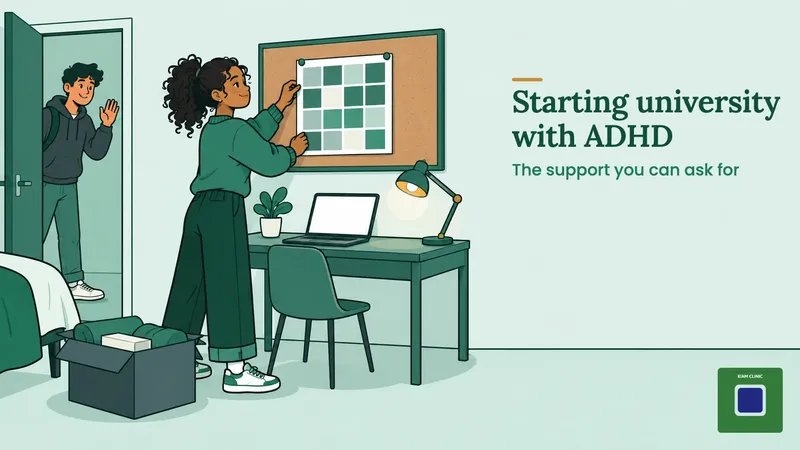
If you have ADHD and are starting university, you can ask for support with your studies. Your university has a legal duty to make reasonable adjustments, and in England you may also be able to get Disabled Students' Allowance (DSA).
The first weeks bring a lot of change at once. This guide explains the ADHD university support that exists, how to ask for it, and what to do if you haven't been diagnosed.
In short
- Universities must make reasonable adjustments for disabled students, and ADHD can count as a disability.
- DSA can pay for study-related costs, such as equipment or a specialist study helper. You don't pay it back.
- Every university should have someone in charge of disability support you can talk to.
- If you think you have ADHD but have no diagnosis, talk to your GP or ask about an assessment.
Why can starting university feel harder with ADHD?
University often removes the structure that helped you cope before. You may be managing deadlines, meals, money and sleep on your own for the first time.
The Royal College of Psychiatrists explains that as demands and stress increase, people with ADHD are more likely to struggle to keep up. They can become overwhelmed and unwell, but the right support can help prevent this. So asking for support isn't a sign that you can't manage. It's a sensible way to set yourself up well.
What reasonable adjustments can you ask for?
Reasonable adjustments are changes that stop you being put at a disadvantage because of a disability. The Royal College of Psychiatrists says that under the Equality Act 2010, colleges and universities must make them, and that disability covers ADHD.
The NHS page on ADHD in adults says adjustments at your place of study may include:
- a quiet place to work, away from distractions;
- written instructions as well as spoken ones;
- help from another person to plan and structure your tasks.
What you are offered depends on how ADHD affects you. Our ADHD resources page links to more guidance on your rights in education.
What is Disabled Students' Allowance, and can you get it for ADHD?
DSA is money to cover study-related costs you have because of a disability or health condition. GOV.UK's DSA guide names ADHD as an example of a condition it can cover.
Key points from GOV.UK:
- It can pay for specialist equipment, non-medical helpers such as a specialist note-taker, and other disability-related study costs.
- It doesn't depend on household income, and you don't have to pay it back.
- Undergraduates and postgraduates can get up to £27,783 a year.
- You need to be eligible for student finance from Student Finance England, on a course that lasts at least a year.
These details are for students in England. Scotland, Wales and Northern Ireland have their own student finance bodies.
How do you apply for DSA?
You can apply through your online student finance account. If you're applying for other student finance too, you only apply for DSA once.
The steps, in brief:
- Apply online, or from the to-do list in your student finance account.
- Send evidence of your condition. Student Finance England's disability evidence form is completed partly by a medical professional, who may charge a fee. The form also explains when a diagnostic report is needed instead.
- Have a needs assessment, an informal meeting, in person or remote, about the support that would help you.
- Get your support set up. Don't buy equipment before you're told what you've been awarded, as you can't claim it back.
GOV.UK says you'll hear within about four weeks whether your application is successful. Getting support in place can take up to 14 weeks, so applying early helps.
What else helps in the first few weeks?
A few practical steps can make the move smoother:
- Find your university's disability service. GOV.UK says every university should have a person in charge of disability issues who can talk to you about the support on offer.
- Register with a GP near where you now live. The NHS explains that most people register near where they live. If you're already having ADHD treatment, tell your new GP and your specialist team early.
- Protect your sleep. The Royal College of Psychiatrists says poor sleep can make ADHD symptoms worse. A regular bedtime helps, even with a changing timetable.
- Build in structure. A weekly plan and regular mealtimes can replace some of the structure home or school gave you.
Some students also find coaching useful for planning and routines. Our ADHD coaching and therapy is available in English and Farsi/Dari.
Frequently asked questions
Can you get Disabled Students' Allowance for ADHD?
Yes, you may be able to. GOV.UK names ADHD as an example of a condition that DSA can cover, as long as it affects your ability to study. You also need to be eligible for student finance from Student Finance England and to send evidence of your condition. DSA doesn't depend on household income, and you don't have to pay it back.
Do I have to tell my university I have ADHD?
It's your choice. Telling your university's disability service lets them discuss reasonable adjustments with you, such as written instructions or a quieter place to work. Under the Equality Act 2010, universities must make reasonable adjustments so that disabled students aren't put at a substantial disadvantage.
Can I get support at university without an ADHD diagnosis?
DSA needs evidence of your condition, so a diagnosis usually matters for that. You can still speak to your university's disability service about what they offer while you're waiting. If you think you might have ADHD, talking to your GP is a good first step, and the NHS explains that a GP may refer you for a specialist assessment.
When to get help
It's worth getting a professional view if, at university, you notice that:
- deadlines and reading keep slipping, however hard you try;
- you struggle to organise your days without outside structure;
- these difficulties go back to your school days.
If this sounds familiar, you could talk to your GP or book an adult ADHD assessment with one of our consultant psychiatrists, online across the UK or at our Epsom clinic. Only a full assessment can tell you whether ADHD is the explanation. Our assessment fees are listed in full.
Starting university is a big step for anyone. Asking for support early is a practical way to give yourself a fair chance to enjoy it.
Need help now? If you think you might act on thoughts of suicide or you are in danger, call 999 or go to A&E. For urgent mental health help, call NHS 111 and choose the mental health option. You can talk to Samaritans any time, free, on 116 123, or text SHOUT to 85258.
Related reading
- Adult ADHD symptoms: what they can look like day to day: everyday examples, including at college, to compare with your own.
- What Actually Happens in an Adult ADHD Assessment?: what to expect if you decide to be assessed.
References
- ADHD in adults. Royal College of Psychiatrists, 2023.
- ADHD in adults. NHS, 2025.
- Help if you're a student with a learning difficulty, health problem or disability: Disabled Students' Allowance. GOV.UK, 2026.
- Disabled Students' Allowance: disability evidence form (SFE/DSAEVID). Student Finance England, 2024.
- Disability rights: education. GOV.UK, 2026.
- How to register with a GP surgery. NHS, 2025.
Useful resources
- Student finance: sign in: GOV.UK's sign-in page for your student finance account, where you can apply for DSA.
- ADHD UK: a UK charity offering information and online support groups for people affected by ADHD.
- AADD-UK: a site by and for adults with ADHD, listing support groups across the UK.
This article is for general information. It is not a diagnosis or a substitute for advice from a qualified professional who knows your situation.