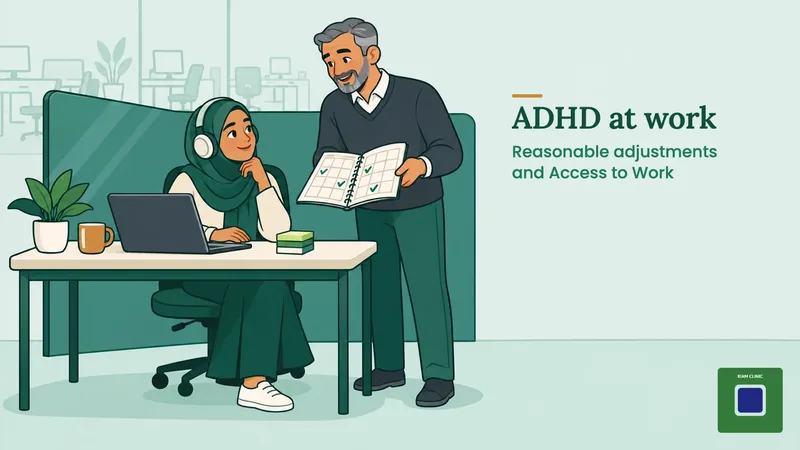
If ADHD makes parts of your job harder, UK law means your employer must consider reasonable adjustments: practical changes that remove a disadvantage you face at work. Separately, the government's Access to Work scheme can pay for extra support, and you do not need a diagnosis to apply.
Many helpful changes cost little or nothing. Here is how adjustments work, what Access to Work offers, and how to start the conversation.
In short
- ADHD can count as a disability under the Equality Act 2010 if it has a substantial, long-term effect on everyday life.
- Employers must make reasonable adjustments so disabled workers are not at a substantial disadvantage.
- Helpful ADHD adjustments include a quiet workspace, written instructions and help planning tasks.
- Access to Work is a government grant for support such as a job coach or software. You do not need a diagnosis to apply.
How can ADHD affect you at work?
ADHD often shows up in the parts of a job that depend on planning and focus. The NHS lists adult ADHD symptoms such as being easily distracted or forgetful, finding it hard to organise your time, and finding it hard to finish tasks.
At work, that might look like:
- Missed details in long emails or meetings.
- Deadlines that creep up because time is hard to judge.
- An open-plan office where every conversation pulls your attention away.
- Restlessness in long meetings, or interrupting without meaning to.
Is ADHD a disability under the Equality Act?
ADHD can be a disability under the law, depending on how it affects you. The Equality Act's definition of disability covers a physical or mental impairment with a "substantial" and "long-term" negative effect on your ability to do normal daily activities.
"Substantial" means more than minor or trivial. "Long-term" means 12 months or more. Whether ADHD meets the definition depends on its effect on you, not on the label alone.
What reasonable adjustments help with ADHD?
GOV.UK explains that employers must make reasonable adjustments so disabled workers are not substantially disadvantaged when doing their jobs.
The NHS suggests adjustments for adults with ADHD such as:
- A quiet workspace, personalised to you.
- Written instructions as well as spoken ones.
- Help from another person to plan and structure your tasks.
Other ideas include:
- A fixed desk instead of hot-desking, an example GOV.UK gives.
- Noise-cancelling headphones, or the chance to move somewhere calmer.
- Hybrid or home working on some days.
A 2026 government report on neurodiversity at work found that many popular adjustments are free or low cost to provide (DWP Expert Academic Panel). It also found early evidence that hybrid working and good-quality coaching help some neurodivergent employees.
Separately, every employee has the legal right to request flexible working from their first day in a job.
What is Access to Work, and can it help with ADHD?
GOV.UK's eligibility page names ADHD among the conditions it covers, and says you do not need a diagnosis to apply.
To be eligible, you need to:
- be 16 or over;
- be in paid work, or due to start or return to paid work within 12 weeks;
- live and work in England, Scotland or Wales. Northern Ireland has a separate scheme.
Access to Work can pay towards things like assistive software, a job coach and specialist equipment. It also offers mental health support: one-to-one sessions with a mental health professional and a plan to help you stay in work. The grant does not affect other benefits and does not have to be paid back.
You can apply online or by phone. You will be asked how your condition affects your work, and your employer will not be contacted without your permission.
How do you talk to your employer about ADHD?
You choose whether, when and how much to share. The 2026 government report found that fear of stigma makes many neurodivergent people less willing to tell their employer.
If you decide to talk, it can help to:
- Focus on the job: what is hard, and what would help.
- Bring two or three ideas, such as "Written actions after meetings would help me keep track."
- Agree a date to review how the changes are working.
Our ADHD resources page gathers guidance on work and education you can share.
Frequently asked questions
Do I need an ADHD diagnosis to get reasonable adjustments?
Not always. Your employer's duty depends on whether you are disabled under the Equality Act, which is about the effect on your daily life rather than a label. Access to Work says you do not need a diagnosis to apply. In practice, a clear assessment report can make it easier to explain your needs and agree what will help.
Do I have to tell my employer I have ADHD?
Whether to share a diagnosis is a personal decision, and many people weigh it up carefully. Bear in mind that it is hard for an employer to make adjustments for a difficulty they do not know about. Some people share only the practical effects, such as "written instructions help me", without naming ADHD at all.
Can my employer refuse a reasonable adjustment?
An employer has to make adjustments that are reasonable, so not every request will be agreed. If a request is turned down, ask why and suggest an alternative. GOV.UK suggests the Disability Employment Adviser at your local Jobcentre Plus and the Equality and Human Rights Commission as places to get advice.
When to get help
It may be worth getting a professional view if:
- you keep falling behind at work despite trying hard, and have done for years;
- you have had warnings over organisation or timekeeping;
- work leaves you exhausted, stressed or low most days;
- you have wondered about ADHD but never been assessed.
If this sounds familiar, our free five-minute ADHD self-screening test is a good first step. It can't diagnose ADHD, but it can help you decide whether to book an adult ADHD assessment with one of our consultant psychiatrists, such as Dr Abbass Mohammadinasab, online or at our Epsom clinic. If you already have a diagnosis, ADHD coaching and therapy can help you build routines that work for you.
The right support at work is not special treatment. It is a fair chance to do your job well.
Need help now? If you think you might act on thoughts of suicide or you are in danger, call 999 or go to A&E. For urgent mental health help, call NHS 111 and choose the mental health option. You can talk to Samaritans any time, free, on 116 123, or text SHOUT to 85258.
Related reading
- Adult ADHD symptoms: what they can look like day to day: more on how ADHD shows up in everyday life, beyond work.
- Free adult ADHD self-test: what the ASRS can and can't tell you: what the screening test measures before you take it.
References
- ADHD in adults. NHS, accessed 2026.
- Definition of disability under the Equality Act 2010. GOV.UK, accessed 2026.
- Reasonable adjustments for workers with disabilities or health conditions. GOV.UK, accessed 2026.
- Expert Academic Panel on Neurodiversity: final report and recommendations. Department for Work and Pensions, 2026.
- Flexible working. GOV.UK, accessed 2026.
- Access to Work: eligibility. GOV.UK, accessed 2026.
- Access to Work: get support if you have a disability or health condition. GOV.UK, accessed 2026.
- Access to Work: apply. GOV.UK, accessed 2026.
Useful resources
- ADHD UK: ADHD and work: a free welfare pack to help you and your employer talk about adjustments.
- AADD-UK: a charity for adults with ADHD, with information and links to local support groups.
- Access to Work: apply online or by phone: the official application, with the helpline number and accessible ways to apply.
This article is for general information. It is not a diagnosis or a substitute for advice from a qualified professional who knows your situation.