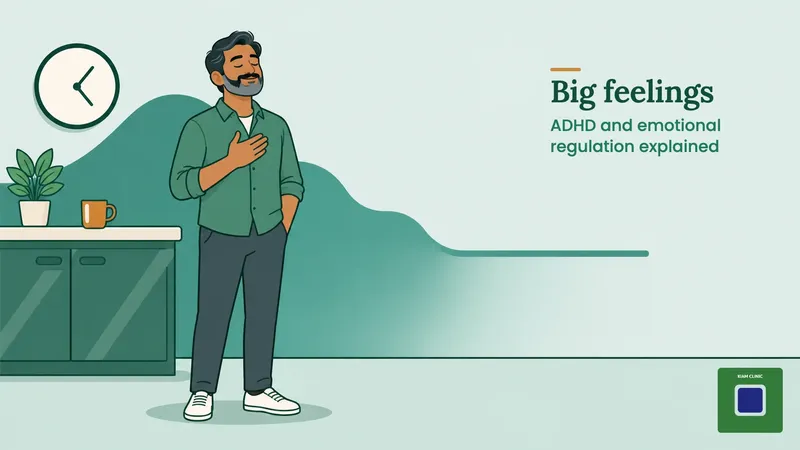
Many people with ADHD find that feelings arrive quickly, hit hard and take real effort to steady. Researchers call this emotional dysregulation, and a review in the American Journal of Psychiatry estimated that it affects between 30% and 70% of adults with ADHD.
It is not a character flaw, and it is not a mood disorder. Here is what ADHD emotional regulation means, what it looks like, and what helps.
In short
- With ADHD, feelings often come quickly and strongly, then pass again within hours.
- Quick frustration, a short temper and rapid ups and downs are common, in adults and in children.
- These ups and downs differ from depression, although the two can occur together.
- Structured psychological support, including CBT, can help.
What is emotional regulation, and why is it harder with ADHD?
Emotional regulation is the set of skills that let you notice a feeling, keep it in proportion and decide what to do next. ADHD is a neurodevelopmental condition, and the Royal College of Psychiatrists explains that such conditions can affect many brain functions, including emotions.
So the differences that make it hard to hold attention, or to pause before acting, can also make it hard to pause before reacting. A 2023 review of 22 studies found that adults with ADHD use unhelpful ways of managing emotions more often than other people, linked to how severe their symptoms were.
What does ADHD emotional dysregulation look like day to day?
It looks like ordinary feelings with the volume turned up and the brakes slow to arrive. The European consensus statement on adult ADHD describes low frustration tolerance, temper outbursts, emotional impulsivity and quick changes of mood.
Day to day, that can mean:
- Quick frustration when something small goes wrong, such as a lost key or a slow website.
- A short fuse in a conversation, followed by regret once the feeling has passed.
- Big reactions to small setbacks, out of proportion to what happened.
- Rapid ups and downs across a single day, often in response to events around you.
The Royal College of Psychiatrists lists anger management problems and family or marriage problems among the signs of unsupported ADHD in adults.
Is emotional dysregulation an official symptom of ADHD?
Not in the diagnostic criteria, but it is a recognised feature. The European consensus notes that DSM-5, the manual used to diagnose ADHD, lists emotional dysregulation as a characteristic feature that supports the diagnosis.
The 2014 review estimated that emotional dysregulation affects around 25–45% of children and 30–70% of adults with ADHD. A 2020 meta-analysis of 13 studies found clearly higher levels in adults with ADHD and concluded that it is a core feature of the condition.
How is it different from depression or a mood disorder?
The main difference is how long the feeling lasts. The European consensus describes ADHD emotional symptoms as short-lived, exaggerated changes, often in response to daily events, with a return to normal within a few hours.
In depression or bipolar disorder, low mood or irritability is sustained over a longer episode. The two can occur together, so a careful assessment looks at both. If low mood lasts for weeks rather than hours, raise it with your GP.
What helps with ADHD emotional regulation?
Support that teaches you to notice and steady feelings, combined with treatment for ADHD itself, tends to help most. NICE guidance on ADHD says psychological treatment for adults with ADHD should be a structured, supportive intervention focused on ADHD, which may include cognitive behavioural therapy (CBT).
Talking therapies
The Royal College of Psychiatrists notes that CBT for ADHD can help with emotional regulation and control. A 2020 systematic review of 32 trials found that most CBT studies showed an improvement in ADHD symptoms, with weaker evidence, from small studies, for mindfulness and group dialectical behaviour therapy (DBT).
At Kiam Clinic, Dr Nazee Akbari, our accredited psychotherapist, offers ADHD coaching and therapy for adults, drawing on CBT, DBT and mindfulness, in English and Farsi/Dari. Emotional regulation is one of the areas she supports clients with.
Everyday steps
The NHS page on anger suggests steps that fit ADHD well:
- Buy yourself a few seconds. Count to ten, or take slow breaths, before you respond.
- Learn your early signs, such as a racing heart or tense muscles, so you can step away sooner.
Medical treatment
Where clinically appropriate, medical treatment for ADHD may also be part of the plan; the 2014 review noted that ADHD treatments often improve emotional dysregulation too.
Frequently asked questions
Is anger a symptom of ADHD?
Anger is not a diagnostic criterion for ADHD, but a quick temper and low frustration tolerance are well-recognised features. The European consensus on adult ADHD describes irritability, frustration and anger that are hard to self-regulate. If anger causes problems at home or work, raise it in an ADHD assessment.
Why do people with ADHD get frustrated so quickly?
Research suggests the brain differences that affect attention and impulse control also affect how emotions are processed and steadied. Feelings arrive quickly, and the pause that would normally soften a reaction arrives late. It is not a lack of effort or self-control, and therapy can help.
Do children with ADHD have emotional dysregulation too?
Yes. The 2014 review estimated that around 25–45% of children with ADHD experience it, often as big reactions to small setbacks, tearfulness or outbursts. If you are worried, talk to your child's GP and the school's SENCo. We also offer ADHD assessments for children and young people with a Consultant Child and Adolescent Psychiatrist.
Can therapy help with ADHD emotional regulation?
It can. NICE recommends a structured psychological intervention focused on ADHD, which may include CBT, and the Royal College of Psychiatrists lists emotional regulation among the things CBT for ADHD can help with. Mindfulness and DBT-based skills also show promise, although the studies so far are small.
When to get help
It may be worth getting a professional view if:
- quick anger or frustration is damaging your relationships, work or studies
- you feel ashamed or worn out by reactions you did not choose
- these patterns go back to childhood, alongside trouble with focus
If this sounds familiar, our free five-minute ADHD self-screening test is a good first step. It can't diagnose ADHD, but it can help you decide whether to book an adult ADHD assessment with one of our consultant psychiatrists, online or at our Epsom clinic.
Big feelings are not a failing. With the right understanding and support, they become easier to live with.
Need help now? If you think you might act on thoughts of suicide or you are in danger, call 999 or go to A&E. For urgent mental health help, call NHS 111 and choose the mental health option. You can talk to Samaritans any time, free, on 116 123, or text SHOUT to 85258.
Related reading
- Adult ADHD symptoms: what they can look like day to day: the fuller picture of adult ADHD, including the flash of frustration that fades quickly.
- ADHD in women and girls: why it is so often missed: why emotional symptoms are sometimes put down to anxiety or depression first.
References
- Emotional dysregulation and attention-deficit/hyperactivity disorder. Shaw P et al., American Journal of Psychiatry, 2014.
- ADHD in adults. Royal College of Psychiatrists, 2023.
- Evidence of emotion dysregulation as a core symptom of adult ADHD: a systematic review. Soler-Gutiérrez AM et al., PLoS One, 2023.
- Updated European Consensus Statement on diagnosis and treatment of adult ADHD. Kooij JJS et al., European Psychiatry, 2019.
- Emotion dysregulation in adults with attention deficit hyperactivity disorder: a meta-analysis. Beheshti A et al., BMC Psychiatry, 2020.
- Attention deficit hyperactivity disorder: diagnosis and management (NG87), Recommendations. NICE, 2018, updated 2019.
- Non-pharmacological interventions for adult ADHD: a systematic review. Nimmo-Smith V et al., Psychological Medicine, 2020.
- Get help with anger. NHS, 2026.
Useful resources
- ADHD UK: a UK charity with information, support groups and guidance on diagnosis pathways for people with ADHD.
- AADD-UK: a charity run by and for adults with ADHD, with peer support groups and a forum.
- Samaritans: free, confidential support any time, on 116 123, for anyone who is struggling to cope.
This article is for general information. It is not a diagnosis or a substitute for advice from a qualified professional who knows your situation.