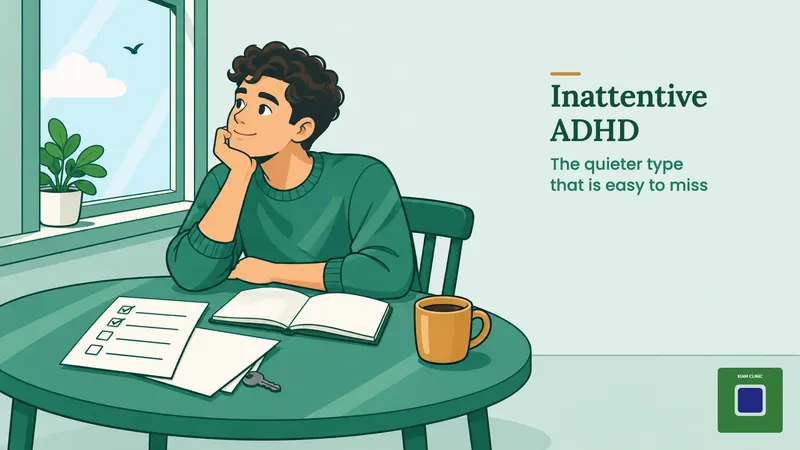
Inattentive ADHD is ADHD where the main difficulties are with focus, organisation and forgetfulness, with few or no signs of hyperactivity. Because it is quiet rather than disruptive, it can easily be missed in children and adults, sometimes for many years.
You may have heard it called ADD. Here is what it looks like, why it is overlooked, and how it is diagnosed.
In short
- ADHD has two groups of symptoms: inattention, and hyperactivity-impulsivity. Some people mainly have the first.
- Signs include being easily distracted, forgetful and disorganised, losing things and leaving tasks unfinished.
- It is easy to miss because it rarely disrupts anyone, and many people learn to hide it.
- Your pattern of symptoms can change as you grow up.
What is inattentive ADHD?
The NHS explains that ADHD symptoms fall into two types: inattentive, and hyperactive-impulsive. Most people with ADHD have symptoms of both types, but some only show signs of one.
DSM-5, the diagnostic manual many clinicians use, calls this pattern the "predominantly inattentive presentation". A review of the DSM-5 changes explains why the word "presentation" replaced "subtype": it describes a person's symptoms now, which may change over time.
What are the signs of inattentive ADHD?
The main signs affect attention, memory and organisation. The Royal College of Psychiatrists lists inattentive symptoms including:
- Missing details and making mistakes at school or work.
- Struggling to focus on tasks, or to listen when someone speaks to you directly.
- Leaving work, chores or other duties unfinished.
- Trouble organising tasks and activities.
- Avoiding tasks that take mental effort over a long time, such as homework or paperwork.
- Losing things like keys, phones, glasses or school books.
- Being easily distracted and forgetful.
For example, a child might drift off in lessons and come home without their reading book most days. An adult might have a desk of half-finished projects and a pile of unopened post.
Why is inattentive ADHD so easy to miss?
It does not draw attention. A child who calls out in class gets noticed; one who quietly daydreams may not. The Royal College of Psychiatrists notes that boys are more likely to show hyperactive and impulsive symptoms, which are more noticeable.
Other reasons include:
- It is under-recognised in girls and women. NICE guidance on ADHD says girls and women are less likely to be referred for assessment. The NHS says this may be because they more often have inattentive symptoms, which are harder to spot.
- People learn to hide it. People with ADHD often develop ways to hide their symptoms, which can be exhausting and affect their mental health.
- Other conditions can mask it. Diagnoses such as anxiety or depression can make the ADHD harder to recognise.
Can your type of ADHD change over time?
Yes. The Royal College of Psychiatrists says ADHD usually begins in childhood and, for most people, continues into adult life, though it may change or improve.
The DSM-5 review notes that some people who now have the inattentive presentation had the combined presentation, with both groups of symptoms, when they were younger. Others have always had few, if any, hyperactive symptoms.
How is inattentive ADHD diagnosed?
It is diagnosed like any ADHD: through a full specialist assessment. NICE says symptoms must cause at least moderate difficulties, happen often, and show up in two or more important areas of life, such as home, school, work or relationships.
Under DSM-5, several symptoms need to have been present before the age of 12. Older teenagers and adults need at least five symptoms in a group, rather than the six needed for younger children.
Our adult ADHD assessment is a 75–90 minute appointment with a consultant psychiatrist, using DSM-5 criteria and NICE guidance, online or at our Epsom clinic. It looks at your childhood as well as how things are now.
Frequently asked questions
Is ADD the same as inattentive ADHD?
Mostly, yes. The DSM-5 review explains that Attention Deficit Disorder (ADD), with or without hyperactivity, was the official name in 1980. It was later renamed ADHD. Today the quieter pattern is called the predominantly inattentive presentation of ADHD. Many people still say ADD in everyday conversation, and it usually means ADHD without obvious hyperactivity.
Can you have ADHD without being hyperactive?
Yes. The NHS says most people with ADHD have both inattentive and hyperactive-impulsive symptoms, but some only show signs of one type. Someone with mainly inattentive symptoms can still be diagnosed with ADHD, as long as their symptoms started in childhood and cause real difficulties in more than one area of life, such as home and work.
Is inattentive ADHD milder than other types?
Not necessarily. Quieter symptoms are not the same as smaller problems. For any ADHD diagnosis, NICE says symptoms must cause at least moderate difficulties in two or more areas of life, such as home, work or study. The Royal College of Psychiatrists also notes that hiding symptoms can be exhausting and can affect mental health.
Can inattentive ADHD be diagnosed in adults?
Yes. NICE says ADHD should be considered in all age groups. Because symptoms usually start before the age of 12, the NHS says a specialist will ask how your symptoms affected you at school. They may also want to speak to someone who knows you well, such as a family member or close friend.
When to get help
It may be worth getting a professional view if:
- you have struggled with focus, organisation or forgetfulness for as long as you can remember;
- these difficulties affect your work, study, home life or relationships;
- a teacher has said your child often seems far away or does not finish their work.
If this sounds familiar, our free five-minute ADHD self-screening test is a good first step. It can't diagnose ADHD, but it can help you decide whether to book an assessment with one of our consultant psychiatrists, such as Dr Mohammad Saidi, online or at our Epsom clinic.
If you are worried about your child, talk to their teacher or the school's SENCo, and to your GP. We also offer a child ADHD assessment with a Consultant Child and Adolescent Psychiatrist.
Being quiet is not the same as coping. Understanding your attention can be the first step towards support that fits.
Need help now? If you think you might act on thoughts of suicide or you are in danger, call 999 or go to A&E. For urgent mental health help, call NHS 111 and choose the mental health option. You can talk to Samaritans any time, free, on 116 123, or text SHOUT to 85258.
Related reading
- ADHD in women and girls: why it is so often missed: why quiet, inattentive ADHD in girls and women is so often overlooked.
- Adult ADHD symptoms: what they can look like day to day: everyday examples of ADHD at work, at home and in relationships.
References
- Attention deficit hyperactivity disorder (ADHD) in adults. NHS, 2025.
- Changes in the definition of ADHD in DSM-5: subtle but important. Epstein JN, Loren REA. Neuropsychiatry, 2013.
- ADHD in adults. Royal College of Psychiatrists, 2023.
- Attention deficit hyperactivity disorder: diagnosis and management (NG87), Recommendations. NICE, 2018, updated 2019.
Useful resources
- ADHD UK: a charity offering information about ADHD for adults and families, and ways to connect with others.
- AADD-UK: a charity for adults with ADHD, with information and links to local support groups.
- NHS: ADHD in children and young people: plain-English guidance for parents, including how to get support at school.
This article is for general information. It is not a diagnosis or a substitute for advice from a qualified professional who knows your situation.