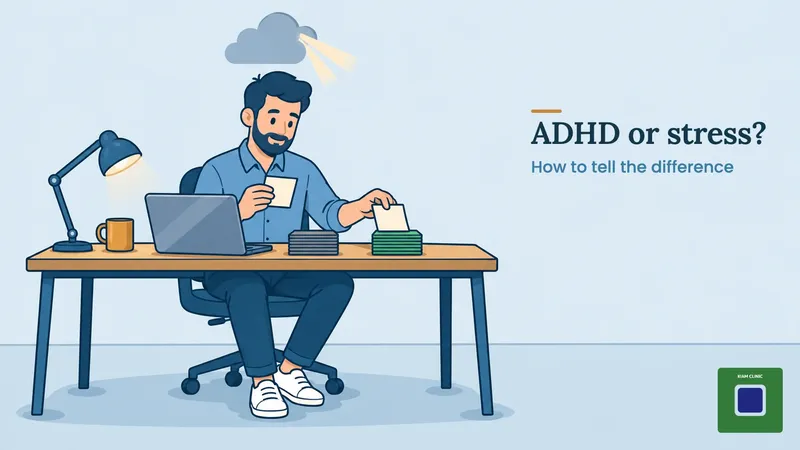
ADHD or stress? Both can make it hard to concentrate, remember things and stay calm. The main difference is timing. Stress is usually a reaction to pressure, while ADHD is a lasting pattern that starts in childhood and shows up across different parts of life.
The two can also overlap, so it isn't always one or the other. This guide explains the differences, and when to get a professional view.
In short
- Stress can cause poor concentration, forgetfulness and irritability, much like ADHD.
- ADHD symptoms usually start before the age of 12 and continue over time, in more than one setting.
- Stress doesn't cause ADHD, but it can make existing ADHD harder to live with.
- Poor sleep, low mood and other conditions can also look like ADHD.
- Only a specialist assessment can tell whether ADHD is part of the picture.
What does stress do to your focus and memory?
The NHS lists mental symptoms of stress that include:
- difficulty concentrating;
- struggling to make decisions;
- feeling overwhelmed or constantly worrying;
- being forgetful.
Stress can also make you irritable, change how you sleep and eat, and cause physical symptoms such as headaches, muscle tension or stomach problems.
The NHS describes stress as usually a reaction to mental or emotional pressure, such as work, money, family or health worries. It also notes that it's not always easy to recognise when stress is the cause.
ADHD or stress: how are they different?
ADHD is a lifelong pattern, not a reaction to a hard patch. NICE guidance on ADHD says that for a diagnosis, symptoms must happen often, show up in two or more important settings and cause at least moderate difficulties.
Some differences to think about:
- When it started. The NHS says ADHD symptoms usually start before the age of 12. Stress tends to follow a demanding time, such as a new job or a family problem.
- Where it shows up. ADHD affects several areas of life, such as home, work and relationships. Stress is often linked to a particular source of pressure.
- What else is there. ADHD can involve restlessness and impulsivity, such as interrupting or making quick decisions without thinking. Stress can bring constant worry and physical symptoms, such as muscle tension.
You can read more about how ADHD is assessed and treated at every age.
Can stress make ADHD symptoms worse?
Yes. Stress doesn't cause ADHD, but it can make ADHD symptoms harder to manage.
The Royal College of Psychiatrists explains that as demands and stress increase, people with ADHD are more likely to struggle to keep up. They can become overwhelmed and unwell. New challenges in adult life, such as leaving home or becoming a parent, can bring ADHD difficulties to the surface for the first time.
Sleep matters too. The Royal College of Psychiatrists says poor sleep can make ADHD symptoms worse. The NHS adds that anxiety and depression can also make ADHD symptoms worse.
That's why some adults first wonder about ADHD during a stressful period. The stress may be real, and so might a pattern that was there long before it.
ADHD vs stress symptoms: questions to ask yourself
These questions can't diagnose anything, but they may help you notice the pattern.
- Can you remember similar difficulties at school, or did teachers comment on them?
- Do they show up at home, at work and socially, or mainly in one place?
- Did they continue during calmer times, such as holidays?
- Is there a clear source of pressure in your life right now?
- Has a family member been diagnosed with ADHD? The NHS says ADHD often runs in families.
For example, one person might have always lost keys and missed deadlines, even in easy years. Another might find their focus only slipped after a stressful house move.
What else can look like ADHD?
Several things can affect attention and memory. NICE notes that ADHD symptoms can overlap with those of other conditions, so a careful assessment is needed.
When you see your GP, they may consider conditions such as autism, Tourette's or anxiety, according to the NHS.
What helps with stress in the meantime?
Whatever the cause, the NHS suggests:
- talking about your feelings with a friend, family member or health professional;
- simple time-management techniques, such as planning ahead and making lists;
- breathing exercises for stressful moments;
- setting small targets, rather than trying to do everything at once.
If you're 18 or over, the NHS says you can usually refer yourself to NHS Talking Therapies for help with stress, without seeing a GP first.
Frequently asked questions
Can stress cause ADHD?
No. ADHD is a neurodevelopmental condition that starts in childhood. The Royal College of Psychiatrists says it's usually caused by a mix of genetic and environmental factors, such as difficulties before birth or a brain injury. Stress later in life doesn't create ADHD, but it can make existing symptoms more noticeable and harder to manage.
Can ADHD be mistaken for stress or anxiety?
Sometimes. NICE notes that ADHD symptoms can overlap with those of other conditions, and the NHS says anxiety and depression often occur alongside ADHD. The Royal College of Psychiatrists says some people receive a diagnosis like anxiety or depression when it only explains part of their difficulties.
When should I see a GP about stress?
The NHS suggests seeing a GP if you're struggling to cope with stress, or if the things you're trying yourself aren't helping. You can also ask your GP for a referral instead of referring yourself to talking therapies. If you think ADHD could be part of the picture, it's worth mentioning this at the same appointment.
When to get help
It's worth getting a professional view if difficulties with focus, memory or restlessness:
- go back to your school days;
- continue even when life is calmer;
- are affecting your work, studies or relationships.
If this sounds familiar, you could talk to your GP or book an adult ADHD assessment with one of our consultant psychiatrists, online or at our Epsom clinic. Only a full assessment can tell you whether ADHD is the explanation. Our fees page sets out what an assessment costs.
Feeling stretched thin is hard, whatever the cause. Taking time to understand what's going on is a kind first step, and our team is happy to answer your questions.
Need help now? If you think you might act on thoughts of suicide or you are in danger, call 999 or go to A&E. For urgent mental health help, call NHS 111 and choose the mental health option. You can talk to Samaritans any time, free, on 116 123, or text SHOUT to 85258.
Related reading
- Adult ADHD symptoms: what they can look like day to day: everyday examples to compare with your own.
- What Actually Happens in an Adult ADHD Assessment?: what to expect if you decide to be assessed.
References
- Stress. NHS, 2026.
- Attention deficit hyperactivity disorder: diagnosis and management (NG87). NICE, 2018, updated 2019.
- ADHD in adults. NHS, 2025.
- ADHD in adults. Royal College of Psychiatrists, 2023.
Useful resources
- Every Mind Matters: stress (NHS): practical NHS tips and self-help techniques for managing stress.
- Find NHS Talking Therapies: search for a local NHS talking therapies service you can refer yourself to.
- ADHD UK: a UK charity offering information and online support groups for people affected by ADHD.
This article is for general information. It is not a diagnosis or a substitute for advice from a qualified professional who knows your situation.