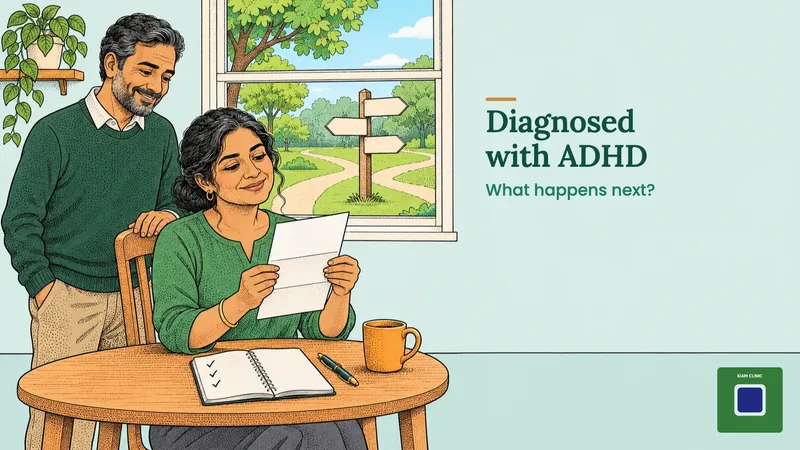
After an ADHD diagnosis, your specialist should talk you through what it means for your life and agree a treatment plan with you. That plan can include changes at home and work, talking therapies or coaching, and medication if it is right for you, with regular reviews along the way.
For many people, a diagnosis is the start of understanding themselves better. Here is what usually happens next.
In short
- Relief, frustration and sadness are all normal after a diagnosis.
- Your specialist should discuss how ADHD affects your life and build a treatment plan with you.
- Changes to routines and surroundings usually come first; therapy, coaching and medication are options, not obligations.
- If you start medication, you will have regular reviews, and your GP may later take over prescribing.
- You must tell the DVLA only if ADHD or its treatment affects your driving.
How might you feel after an ADHD diagnosis?
Most people go through a period of adjustment. The Royal College of Psychiatrists describes three common feelings:
- Relief at finally having an explanation, and knowing you are not "lazy".
- Frustration that it was not noticed sooner.
- Sadness about missed chances.
These feelings can come and go. ADHD is part of you, but it is not the most important thing about you.
What should your specialist talk to you about?
NICE guidance on ADHD says that after a diagnosis, your specialist should have a structured conversation with you about how ADHD could affect your life. This can cover:
- the positives, such as building on your strengths, and downsides, such as stigma;
- school, college or work, including reasonable adjustments;
- relationships, other conditions and driving.
This feeds into a shared treatment plan that you agree together, based on your needs and goals. You can bring a partner, friend or relative along for support.
What are the treatment options after diagnosis?
There is no single treatment for ADHD. NICE describes several routes, and you can combine them.
Changes to your surroundings and routines
NICE calls these "environmental modifications": practical changes that reduce the effect of ADHD on daily life, such as a quieter workspace or written as well as spoken instructions. The Royal College of Psychiatrists says they can be one of the most important parts of support.
Lifestyle
The NHS recommends regular exercise, enough sleep and a balanced diet with regular mealtimes.
Talking therapies and coaching
NICE recommends a structured psychological approach focused on ADHD for adults who choose not to take medication, and says it can also be considered alongside medication. The NHS mentions cognitive behavioural therapy (CBT), and coaching can help with everyday skills such as time management. At Kiam, we offer ADHD coaching and therapy in English and Farsi/Dari.
Medication
For adults, NICE says medication should be offered if ADHD is still causing significant difficulties after changes to your surroundings have been tried and reviewed. It must be started by a specialist, and the choice is yours to make with your doctor.
What happens if you start medical treatment?
Our ADHD medication management page explains the health checks before treatment, and each step after.
While treatment is being set up, our ADHD follow-up appointments take place every 3–4 weeks. Once things are stable, reviews move to every 3–4 months.
After you have been stable for at least four weeks, we can offer a shared care agreement. Your GP takes over routine prescribing while we stay responsible for specialist review. Some practices decline shared care, so ask yours early. NICE says medication should be reviewed at least once a year.
Who do you need to tell?
Some people may need to know.
- The DVLA: GOV.UK says you must tell the DVLA if your ADHD or your ADHD medication affects your ability to drive safely. Ask your doctor if you are unsure.
- Your employer, college or university: telling them can open the door to reasonable adjustments. The Royal College of Psychiatrists notes that the Equality Act 2010 covers ADHD as a disability. Access to Work can also fund practical support, such as a job coach.
- Family and friends: the College suggests telling people what does and doesn't help you.
NICE also says you should be told about support groups and charities. ADHD UK and AADD-UK are good places to start (see Useful resources).
Frequently asked questions
Do I have to take medication after an ADHD diagnosis?
No. The NHS says not everyone needs or wants medicine to manage ADHD. NICE sets out non-medical options too, including changes to your surroundings and talking therapies, and these can be used instead of medication or alongside it. Your specialist will explain the benefits and possible downsides of each option, so you can make an informed choice about what suits you best.
Can I change my mind about treatment later?
Yes. NICE says people should be reassured that they can revisit decisions about treatment. Your plan should be discussed regularly, not just once, because your needs and circumstances change over time. If something isn't working, or you would like to try a different approach, raise it at your next review, and your specialist will talk through the options again.
What happens after my child is diagnosed with ADHD?
The specialist will explain what the diagnosis means and the support available. The NHS suggests talking to the school's special educational needs coordinator (SENCo) about changes that could help at school and at home. NICE recommends advice for parents on clear routines and positive time together, and stresses that this does not imply poor parenting.
When to get help
It is worth speaking to your specialist or GP if:
- difficult feelings about your diagnosis are not settling, or your mood is low;
- ADHD is still causing problems at work, at home or in relationships;
- you have questions about treatment or shared care.
If you are diagnosed with us, we guide you through each step. Dr Abbass Mohammadinasab, our Lead Consultant Psychiatrist, assesses and treats adults with ADHD, online or at our Epsom clinic.
Not been assessed yet? Our free five-minute ADHD self-screening test can't diagnose ADHD, but it can help you decide whether to book an assessment.
A diagnosis is a starting point. With the right plan and support, daily life can become easier to manage.
Need help now? If you think you might act on thoughts of suicide or you are in danger, call 999 or go to A&E. For urgent mental health help, call NHS 111 and choose the mental health option. You can talk to Samaritans any time, free, on 116 123, or text SHOUT to 85258.
Related reading
- Starting ADHD medication in the UK: titration and shared care: how treatment is checked and adjusted.
- ADHD at work: reasonable adjustments and Access to Work: support you can ask for at work.
- Starting university with ADHD: the support you can ask for: help if you are studying.
References
- ADHD in adults. Royal College of Psychiatrists, 2023.
- Attention deficit hyperactivity disorder: diagnosis and management (NG87), Recommendations. NICE, 2018, updated 2019.
- Attention deficit hyperactivity disorder (ADHD) in adults. NHS, 2025.
- Attention deficit hyperactivity disorder (ADHD) and driving. GOV.UK, DVLA.
- Access to Work: get support if you have a disability or health condition. GOV.UK, Department for Work and Pensions.
- ADHD in children and young people. NHS.
Useful resources
- ADHD UK: a charity offering information, support groups and guidance for adults and families.
- AADD-UK: a charity for adults with ADHD, with links to local peer support groups.
- YoungMinds: ADHD guide for parents: practical advice for parents supporting a child or teenager with ADHD.
This article is for general information. It is not a diagnosis or a substitute for advice from a qualified professional who knows your situation.