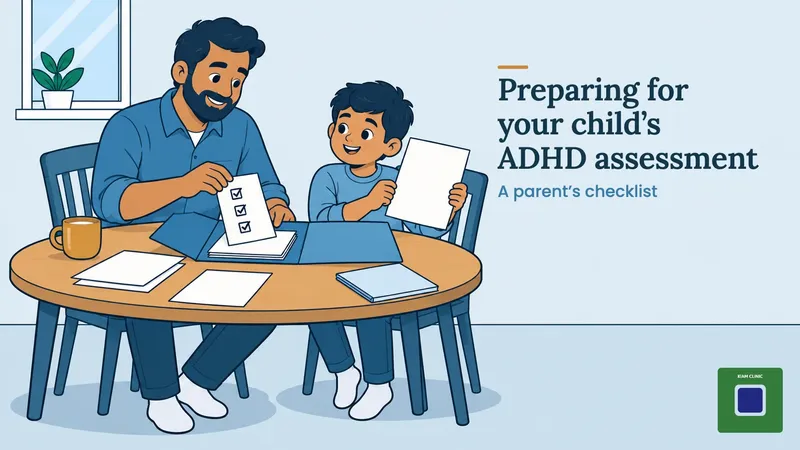
The most useful way to prepare for a child ADHD assessment is to gather a clear picture of how your child is at home and at school, from early childhood to now. A little preparation helps the specialist see the whole picture, and helps you feel ready.
This checklist covers what to gather, how to involve the school and how to talk to your child.
In short
- An ADHD assessment is a detailed conversation with a specialist, not a single test.
- Gather notes on your child's early development, school reports and any support plan.
- Write down a few recent, specific examples from home and from school.
- Tell the school early: the specialist will usually want a teacher's view.
- Explain the appointment to your child simply: it is a chance to talk, not a test to pass.
What happens in a child ADHD assessment?
A child ADHD assessment is a structured conversation with a specialist, using information from more than one place. NICE guidance on ADHD says a diagnosis should be made by a specialist, based on a full developmental history, observer reports and how symptoms show up across different settings.
The NHS explains that the specialist talks with you and your child, and asks about development, such as when your child learned to walk or read. There may be forms to fill in first, and the specialist will usually contact a teacher or the school's special educational needs co-ordinator (SENCo).
What should you gather before the appointment?
Most of this is collecting things you already have:
- Early development. Note roughly when your child walked, talked and started reading. If you still have their personal child health record (the "red book"), the NHS explains it records growth and development milestones, so it can jog your memory.
- School information. Reports, teacher comments and any support plan.
- A note from school. YoungMinds suggests asking the teacher or SENCo for a short summary of your child's behaviour and experiences at school, and any support they get.
- Health information. Any other health conditions and earlier reports, such as hearing or speech and language checks. NICE says an assessment should also look at physical health and other conditions.
- Family history. Whether a close relative has ADHD. NICE notes that ADHD is more common when a close family member has it.
Why write down examples from home and school?
Specific examples show the specialist how often difficulties happen and how much they get in the way. NICE says that, for a diagnosis, symptoms should happen often, cause at least moderate difficulties, and show up in two or more important settings, such as home and school.
So for a week or two, jot down short, real examples: homework that took two hours because your child kept losing their place, or a teacher mentioning they often leave their seat. YoungMinds also suggests a diary of times and triggers for moments when your child becomes frustrated or overwhelmed.
Include what goes well, too: strengths and interests matter.
How do you involve your child's school?
Tell the school early. NICE says rating scales, such as the Conners' rating scales, are helpful extra tools, although a diagnosis should never rest on them alone.
At Kiam Clinic, we send questionnaires for you and, with your permission, for your child's school to complete before the appointment. Telling the class teacher in advance gives them time to complete theirs carefully.
How can you prepare your child?
Keep it simple and honest: they will talk with a doctor about what feels easy and what feels hard, at home and at school. YoungMinds points out that there is no single test for ADHD, so there is nothing to pass or fail.
NICE also says children and young people's views should be taken into account wherever possible. In our child and adolescent ADHD assessment, the psychiatrist hears your child's own account, in their own words, alongside yours.
What happens on the day, and afterwards?
Our child assessments are led by Dr Hadi Shaker Naeeni, our Consultant Child and Adolescent Psychiatrist, and usually take 90 to 120 minutes. They are online by secure video or in person at our Epsom clinic in Surrey, with the same clinician and written report either way.
Have these ready:
- Your questions, written down, so nothing is forgotten.
- Your own perspective. NICE says the assessment should also consider how things are for parents and carers, so you may be asked how you are doing too.
- Consent. Consent is normally given by a person with parental responsibility. A young person with enough understanding may consent for themselves.
Afterwards, you receive a written report and your GP receives a letter. If your child is diagnosed, we discuss the options with you, which may include support for parents, strategies at home and at school, and treatment where appropriate.
Frequently asked questions
What should I bring to my child's ADHD assessment?
Bring notes on your child's early development, such as when they walked and talked, and their red book if you have it. Add recent school reports, any support plan, and a short note from the teacher or SENCo if possible. Specific examples from home and school, and your own written questions, help you make the most of the time.
Does the school need to provide a report for an ADHD assessment?
ADHD can only be diagnosed when difficulties show up in more than one setting, so a teacher's view is important. NICE says rating scales from parents and teachers are helpful extra tools, though never enough on their own. At Kiam Clinic, we send a questionnaire to your child's school, with your permission, before the appointment.
Should my child come to their ADHD assessment?
Yes. The NHS explains that the specialist talks with both you and your child, and NICE says children and young people's views should be taken into account wherever possible. Tell your child honestly what will happen, in words that suit their age. You may also have a chance to talk with the specialist about things you would rather not discuss in front of them.
When to get help
It may be worth asking for a professional view if:
- difficulties with attention, restlessness or impulsivity have lasted for months
- they show up at home and at school
- schoolwork, friendships or family life are being affected
A good first step is to talk to the school's SENCo and your GP. YoungMinds notes that school support should be based on your child's needs, not on a diagnosis. If you would like a specialist opinion, we offer ADHD assessments for children and young people with a Consultant Child and Adolescent Psychiatrist. Today, a child ADHD assessment costs £1,395 online or £1,695 in person; you can see all our fees and compare our assessment options.
Whatever the outcome, the picture you gather will help everyone support your child better.
Related reading
- Signs of ADHD in children: what parents and teachers notice first: the signs to think about as you note examples.
- Private ADHD assessment cost in the UK: what should be included?: what a thorough assessment should include.
References
- Attention deficit hyperactivity disorder: diagnosis and management (NG87), Recommendations. NICE, 2018, updated 2019.
- ADHD in children and young people. NHS, 2025.
- Your baby's health and development reviews. NHS, 2023.
- ADHD: a guide for parents and carers. YoungMinds, 2026.
Useful resources
- ADHD UK: a UK charity with information for families, support groups and guidance on the routes to diagnosis.
- YoungMinds Parents Helpline: free advice for parents and carers worried about a child or young person.
- NHS: ADHD in children and young people: plain-English information on signs, getting help and support at school.
This article is for general information. It is not a diagnosis or a substitute for advice from a qualified professional who knows your situation.