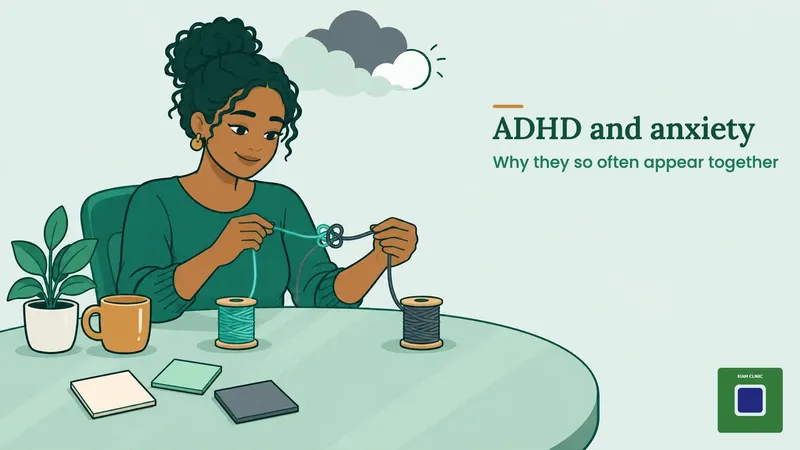
ADHD and anxiety often appear together. Anxiety disorders are more common in people with ADHD than in people without it, and the two share signs such as restlessness, poor concentration and broken sleep.
That overlap can make it hard to know what is going on. This article explains why the two so often travel together, how to tell them apart, and what helps.
In short
- Anxiety is one of the conditions that most often occurs alongside ADHD, in adults and in children.
- ADHD and anxiety share several signs, including restlessness, trouble concentrating and difficulty sleeping.
- Anxiety can sometimes hide ADHD, so the ADHD is missed.
- Anxiety and depression can make ADHD symptoms worse.
- A careful assessment can untangle the two, and each can be treated.
Why do ADHD and anxiety appear together so often?
Anxiety is more common in people with ADHD, though researchers are still working out why. The Royal College of Psychiatrists lists anxiety among the conditions that are more common in adults with ADHD, alongside depression and sleep disorders.
A 2022 review of 32 studies found anxiety disorders among the most frequent conditions in adults with ADHD. Exact figures vary between studies.
It is not only adults. A 2025 analysis of 121 studies of children and teenagers with ADHD found that about 18% also had an anxiety disorder.
Part of the answer may be shared roots: the Royal College of Psychiatrists notes that the genetic and environmental factors linked to ADHD are also found in other common mental health conditions.
Where do the symptoms of ADHD and anxiety overlap?
Several signs can belong to either condition. The NHS lists the symptoms of generalised anxiety disorder (GAD), a common type of anxiety, as including:
- feeling restless or on edge
- finding it difficult to concentrate
- difficulty sleeping
- feeling irritable
- getting tired easily
Restlessness, distractibility and poor sleep are also common in ADHD. A review in Current Psychiatry Reports describes this ADHD anxiety overlap as one reason the combination is hard to diagnose.
Can anxiety hide ADHD?
Yes, sometimes it can. The Royal College of Psychiatrists explains that some people are diagnosed with a mental health problem such as anxiety or depression when it only explains part of their difficulties. When that happens, underlying ADHD can be missed.
The College adds that girls and women may be more likely to receive an incorrect diagnosis of another condition. If you've been treated for anxiety and still struggle with focus and organisation, it may be worth asking whether ADHD has been considered.
Is it ADHD or anxiety? What an assessment looks at
Only a full assessment can tell them apart. NICE guidance on ADHD says adult ADHD symptoms should have begun in childhood and continued throughout life, and that an assessment should include any coexisting conditions.
So a clinician will usually ask:
- When did it start? ADHD traits go back to childhood, so a clinician looks for signs from your early years.
- What drives it? Worry that is hard to control is the core of GAD. Inattention and restlessness are the core of ADHD.
- Could it be both? The two often occur together, so both are considered.
You can read more about ADHD and how it is diagnosed in our ADHD section.
What helps when you have both ADHD and anxiety?
Looking at both matters: the NHS page on adult ADHD notes that anxiety and depression can make ADHD symptoms worse.
Talking therapy
The NHS says talking therapy, usually cognitive behavioural therapy (CBT), is often the first treatment for GAD. NICE also recommends that non-medication approaches are considered for adults with ADHD.
At Kiam Clinic, Dr Nazee Akbari, our accredited psychotherapist, offers ADHD coaching and therapy, in English and Farsi/Dari. Her work includes people who also experience anxiety.
Everyday steps that may help
The NHS suggests self-help steps for anxiety, including:
- Move regularly. The Royal College of Psychiatrists says exercise has been shown to reduce anxiety symptoms in people with ADHD.
- Protect your sleep with a regular bedtime.
- Cut back on caffeine, which can disrupt sleep and make anxiety harder to control.
- Face worries gradually, rather than avoiding them.
Medical treatment
Where clinically appropriate, medical treatment may be part of the plan. A psychiatrist will talk this through with you.
Frequently asked questions
Can ADHD cause anxiety?
Researchers don't yet fully understand why the two are linked. What is clear is that anxiety is more common in people with ADHD than in people without it. Some people find that years of struggling with unrecognised ADHD symptoms add to their worry. An assessment can look at both and how they affect each other in your life.
Can anxiety be mistaken for ADHD?
Yes. Anxiety can make it hard to concentrate, settle or sleep, which can look like ADHD. The reverse also happens: the Royal College of Psychiatrists notes that some people are diagnosed with anxiety when it only explains part of their difficulties, and their ADHD is missed. A full assessment looks for both.
Do children with ADHD get anxiety too?
They can. A large 2025 review found that about 18% of children and teenagers with ADHD also had an anxiety disorder. If you're worried about your child, talk to their GP and the school's SENCo (special educational needs co-ordinator). Kiam Clinic also offers ADHD assessments for children and young people.
Which should be treated first, ADHD or anxiety?
There is no single rule. It depends on which difficulties affect you most, and on your own preferences. NICE recommends that an ADHD assessment includes any coexisting conditions, so the plan can take both into account. A psychiatrist will agree the order of treatment with you.
When to get help
It may be worth getting a professional view if:
- worry, restlessness or poor focus affect your work, studies or relationships most days
- you've been treated for anxiety, but focus and organisation are still a struggle
- you've noticed these difficulties since childhood
If this sounds familiar, our free five-minute ADHD self-screening test is a good first step. It can't diagnose ADHD, but it can help you decide whether to book an assessment with one of our consultant psychiatrists, online or at our Epsom clinic. If anxiety is your main concern, we also offer an adult anxiety assessment.
Living with both can be tiring, but you don't have to work it out alone.
Need help now? If you think you might act on thoughts of suicide or you are in danger, call 999 or go to A&E. For urgent mental health help, call NHS 111 and choose the mental health option. You can talk to Samaritans any time, free, on 116 123, or text SHOUT to 85258.
Related reading
- Adult ADHD symptoms: what they can look like day to day: for a fuller picture of the ADHD side of the overlap.
- ADHD in women and girls: why it is so often missed: why ADHD in women is often mistaken for anxiety.
References
- ADHD in adults. Royal College of Psychiatrists, 2023.
- The prevalence of psychiatric comorbidities in adult ADHD compared with non-ADHD populations: a systematic literature review. Choi WS et al., PLoS One, 2022.
- Psychiatric comorbidity in children and adolescents with ADHD: a systematic review and meta-analysis. Njardvik U et al., Clinical Psychology Review, 2025.
- Generalised anxiety disorder (GAD). NHS, 2024.
- ADHD and anxiety disorder comorbidity in children and adults: diagnostic and therapeutic challenges. Koyuncu A et al., Current Psychiatry Reports, 2022.
- Attention deficit hyperactivity disorder: diagnosis and management (NG87), Recommendations. NICE, 2018, updated 2019.
- ADHD in adults. NHS, 2025.
Useful resources
- ADHD UK: a UK charity with information and support for people with ADHD and their families.
- AADD-UK: a charity run by and for adults with ADHD, with peer support groups.
- Rethink Mental Illness: anxiety disorders: plain-English information on the types of anxiety and getting support.
- NHS Talking Therapies: adults in England can refer themselves for free talking therapy for anxiety, without a GP referral.
This article is for general information. It is not a diagnosis or a substitute for advice from a qualified professional who knows your situation.