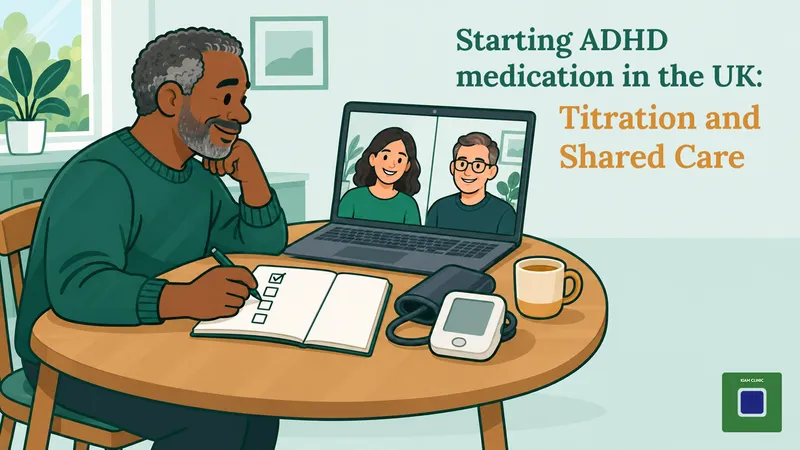
Starting ADHD medication in the UK means health checks first, then careful adjustment of the dose with regular reviews, a process called titration. Once you are stable, your GP may take over routine prescribing under a shared care agreement, while your specialist stays involved.
Each step follows national guidance on ADHD from NICE, the National Institute for Health and Care Excellence. This guide explains ADHD medication titration in the UK, stage by stage.
It covers the process, not specific medicines. Whether medication suits you is a decision you make with your specialist.
In short
- A specialist checks your health first, including heart rate, blood pressure, height and weight.
- Titration means changing the dose step by step, with reviews, until the benefits are clear and any unwanted effects are ones you can live with.
- Monitoring continues while you take medication, with a specialist review at least once a year.
- Once you are stable, your GP may take over routine prescribing through shared care.
- Treatment is a shared decision, and talking therapy or coaching may help too.
What checks happen before ADHD medication is started?
Before anything is prescribed, NICE recommends a full baseline assessment: a record of your health to compare against later. It should include:
- a review to confirm the diagnosis still fits and treatment is needed
- your mental health, any other conditions, your work or education, and your care needs
- a routine check on alcohol and drug use
- your medical history and current medicines
- height and weight
- pulse (heart rate) and blood pressure, using the right size of cuff
- a heart check, including listening to your heart
An ECG (a recording of your heart's rhythm) is not usually needed. But NICE advises seeing a heart specialist first in some cases. Examples include fainting during exercise, or a parent, sibling or child who died suddenly under 40 from a suspected heart problem.
At Kiam, some checks can be arranged through your GP or done privately. Our baseline also includes blood tests to rule out conditions that can mimic or complicate ADHD. Our ADHD medication management page sets out each step.
How does ADHD medication titration work in the UK?
Titration means building the dose up slowly and checking how you respond at each step. The Royal College of Psychiatrists explains that this helps find the right dose while keeping unwanted effects low.
NICE says the right dose brings fewer symptoms and improves behaviour, study, work and relationships, with unwanted effects you can live with. It recommends recording symptoms and unwanted effects before you start and at each dose change, using standard rating scales. For a child, parents and teachers fill these in.
NICE also advises slower titration and closer monitoring for people with another condition, such as autism, a tic disorder, epilepsy or heart disease. And the NHS website notes that some people need to try more than one medicine.
At Kiam, reviews happen every 3–4 weeks while the dose is being adjusted, online or in person. Blood pressure and pulse are checked after every change. You can read how our follow-up appointments work.
For adults, a medication follow-up costs £225 for 20 minutes. You can also see our full list of fees.
How is ADHD treatment monitored once you are stable?
Monitoring carries on for as long as you take ADHD medication. NICE recommends:
- checking heart rate and blood pressure before and after every dose change, and every 6 months
- checking weight every 6 months in adults
- watching for changes in sleep, for example with a sleep diary
- a specialist review at least once a year, to decide with you whether to continue
At Kiam, blood pressure, pulse, height and weight are checked roughly every three months once you are stable. Reviews move to every 3–4 months, with a specialist review every six months. A home blood-pressure monitor makes this easier.
You can help too. NICE encourages people to note unwanted effects between reviews, for example on a simple checklist. ADHD can make it hard to remember to order and collect prescriptions, so alarms and a fixed daily routine can help.
If you drive, you must tell the DVLA if your ADHD or your ADHD medication affects your ability to drive safely.
How does ADHD shared care with your GP work?
Shared care is an agreement between you, your specialist and your GP. Once your dose is stable, your GP takes over routine prescribing, and the specialist reviews stay with your specialist.
NICE recommends shared care for prescribing and monitoring once titration is finished and the dose is stable. At Kiam, we can put a Shared Care Agreement in place after at least four weeks stable on the right treatment. We make no charge for arranging one.
With your consent, we keep your GP informed from the start. Not every practice agrees to shared care, so it is worth asking yours early. We are happy to speak to them directly.
Until shared care is in place, prescriptions come from your specialist. For adults, a repeat prescription once you are stable costs £85 per prescription.
What is different for children and young people?
The steps are the same, but NICE adds safeguards for children and support for families:
- From age 5, medication is offered only if ADHD still causes significant problems after changes at home and school have been tried and reviewed.
- Parents are offered support focused on ADHD, including advice on parenting.
- For children under 5, NICE advises against medication without a second specialist opinion.
- Height and weight are checked regularly and plotted on a growth chart.
- Children and young people are asked to say in their own words how they feel.
Is medication the only option?
No. Medication is one option, and whether to start, change or stop it is your decision, made with your clinician.
Before any treatment starts, NICE asks clinicians to talk through the benefits and harms of medication and other options. That includes lifestyle and exercise, and your own preferences and concerns. You can bring someone close to you into these talks, and you can change your mind later.
For adults, NICE suggests considering psychological support if you prefer not to take medication, find it hard to take, or it hasn't suited you. This can include CBT (cognitive behavioural therapy, a structured talking therapy), and it can also be combined with medication. At Kiam, ADHD coaching and therapy can be used alongside medication or instead of it.
Frequently asked questions
How long does ADHD medication titration take?
There is no fixed timetable: it depends on how you respond. NICE advises slower titration for people with some other conditions, and some people try more than one medicine. At Kiam, reviews are every 3–4 weeks at first, and shared care can be offered after at least four weeks stable.
Can my GP prescribe ADHD medication after a private diagnosis?
It may be possible, through a shared care agreement once your dose is stable. The NHS website explains that a GP can take over prescribing ADHD medicines only under a shared care agreement with the specialist. Not every practice agrees, so ask yours early, and ask your specialist how prescribing would continue if it can't.
Will ADHD medication change my personality?
NICE asks clinicians to explain that ADHD medication does not change personality, because this worry can get in the way of treatment. Titration aims for fewer symptoms, with unwanted effects you can live with. If something doesn't feel right, tell your prescriber: the dose or approach can be changed, or treatment stopped.
Can I stop taking ADHD medication if I want to?
Yes, it's your decision, but talk to your prescriber first so that any change is planned and monitored. NICE encourages people to be involved in any decision to stop or change medication. It also recommends a review at least once a year on whether to continue, and a trial break or lower dose may sometimes be suggested.
When to get help
Talk to your specialist or GP if:
- you have a diagnosis and want to understand your options, with or without medication
- you notice a racing or irregular heartbeat, fainting, or big changes in sleep or weight after starting medication
- you are finding it hard to take treatment as planned
- you would like to know whether shared care is possible
If something worries you, don't wait for your next review. For urgent advice, call NHS 111, and call 999 in an emergency.
If you haven't been assessed yet, talk to your GP, or read about our adult ADHD assessment with one of our consultant psychiatrists, online or at our Epsom clinic.
For a child, talk first to the GP and the school's SENCo (special educational needs coordinator). We also offer child assessments with a Consultant Child and Adolescent Psychiatrist.
Starting ADHD medication is a process, not a single decision, and you stay involved at every step. If you'd like to know how treatment is run at Kiam, you're welcome to ask us at any stage.
Related reading
- What Actually Happens in an Adult ADHD Assessment?: if you haven't been assessed yet, this explains the step before any treatment decision.
References
- Attention deficit hyperactivity disorder: diagnosis and management (NG87). NICE, 2018, updated 2019.
- ADHD in adults. Royal College of Psychiatrists, 2023.
- ADHD in adults. NHS website, 2025.
- Attention deficit hyperactivity disorder (ADHD) and driving. GOV.UK (DVLA), updated 2025.
Useful resources
- ADHD UK: support groups: online peer support groups and communities, including groups for parents.
- YoungMinds: ADHD guide for parents: practical advice on getting help and supporting your child at home and at school, plus a Parents Helpline.
- NHS: ADHD in children and young people: how ADHD can be managed at home, at school and with treatment.
This article is for general information. It is not a diagnosis or a substitute for advice from a qualified professional who knows your situation.