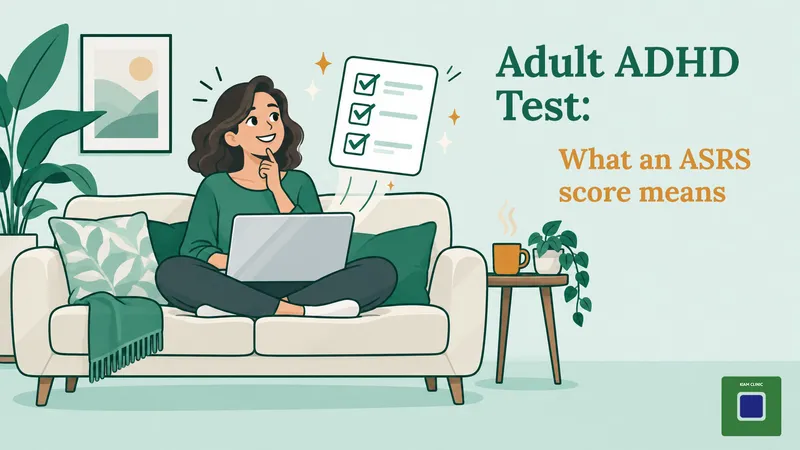
A free adult ADHD test such as the ASRS can show whether your answers look like those of adults with ADHD. It can't tell you whether you have ADHD, because a screener is never a diagnosis.
A screener is a short questionnaire that flags who might need a closer look. Our free, anonymous ADHD self-test is based on the ASRS and takes about five minutes.
In short
- The ASRS screens adults for signs of ADHD. It can't diagnose ADHD or rule it out.
- Results can be wrong both ways: the test can miss ADHD, and it can flag people who don't have it.
- Poor sleep, anxiety and low mood can all produce similar answers.
- Use your result to start a conversation with your GP or a specialist.
What is the ASRS questionnaire?
The ASRS is the World Health Organization's Adult ADHD Self-Report Scale: a short set of questions about attention, restlessness and impulsivity (acting before you think).
Kessler and colleagues published it in 2005, after developing it alongside a World Health Organization mental health interview. The full scale has 18 questions. Six of them form a short screener, chosen because they matched clinicians' diagnoses most closely.
How our free self-test works
Our free ADHD self-test uses these 18 questions, and your answers are recorded anonymously.
- Part A is the six screener questions, and only these are scored.
- Part B is 12 optional questions that can be useful to discuss at an assessment.
- Each question asks how often something happens, from "Never" to "Very often". Your result is a score out of six.
- You can download or print your answers. Any name you add to the printout isn't sent to us.
What can an adult ADHD test tell you?
An adult ADHD test can tell you whether a closer look is worthwhile. The ASRS authors recommended their screener for exactly that: finding people who may need further assessment.
A score of four or more is called a positive screen. It means your answers look a lot like those of adults with ADHD, so a full assessment is worth considering. A lower score makes ADHD less likely on this screener, but it doesn't rule it out.
What can't a screener tell you?
A screener can't diagnose ADHD, rule it out, or explain why you answered as you did.
NICE, which writes health guidance for England and Wales, says ADHD should not be diagnosed from rating scales alone. A rating scale is a questionnaire like the ASRS. The Royal College of Psychiatrists says questionnaires can help, but only a comprehensive interview and assessment can diagnose ADHD accurately.
A questionnaire also misses two things:
- Your childhood. ADHD symptoms usually start before the age of 12, according to the NHS. The ASRS asks only about how things are now.
- The impact on your life. NICE says symptoms should cause at least moderate problems in two or more areas of life, such as work and home. The ASRS asks how often things happen, not how much they affect you.
It also can't tell ADHD apart from other causes of the same difficulties.
Why can the results be wrong?
The ASRS can miss ADHD, and it can flag people who don't have it.
When it misses ADHD
The original 2005 study involved 154 adults in the US. The six questions picked up about 7 in 10 of the people clinicians diagnosed with ADHD, so about 3 in 10 were missed.
People with ADHD also often develop ways to hide their symptoms, the Royal College of Psychiatrists notes. A questionnaire can't see how much effort that takes.
When it flags something else
Very few people without ADHD screened positive in that first study. But results depend on who takes the test.
A 2013 study by van de Glind and colleagues looked at 1,138 adults starting treatment for drug or alcohol problems. Only about 1 in 4 of their positive screens turned out to be ADHD at a full diagnostic interview. The researchers stressed that the ASRS is a screening tool, not a diagnostic one.
What else can look like ADHD on a questionnaire?
Poor sleep, anxiety and low mood can all affect concentration, restlessness and motivation, which are among the things the ASRS asks about.
- Poor sleep. Anyone can struggle to concentrate after a bad night's sleep, as the Royal College of Psychiatrists points out.
- Anxiety. Feeling restless and finding it hard to concentrate can be symptoms of generalised anxiety disorder (ongoing worry that is hard to control), the NHS says.
- Low mood. Depression can mean having no motivation or interest in things, and finding decisions hard.
Anxiety and depression can also exist alongside ADHD, the NHS notes. And ADHD can be missed when they explain only part of someone's difficulties, the Royal College of Psychiatrists says. That is why a GP or specialist considers other possible causes.
How should you use your result?
Treat your result as the start of a conversation, not the end of one.
- Check you answered for recent months, not one unusually good or bad week.
- Save or print your answers, including Part B. A clinician can then see which questions you marked, not just your total.
- Think back to childhood. Did similar difficulties show up at school or at home before the age of 12? If you can, ask someone who knew you then.
- Notice where it happens. Is it at work, at home and with friends, or mostly in one place?
- Consider what else is going on, such as poor sleep, worry or low mood.
What does a full ADHD assessment add?
A full assessment looks at your whole story, not just six answers, so a specialist can judge whether ADHD explains your difficulties.
NICE says ADHD should only be diagnosed by a trained specialist, such as a psychiatrist, after a full assessment. This includes your developmental and mental health history, and reports from people who know you.
At Kiam Clinic, our adult ADHD assessment takes 75 to 90 minutes with a consultant psychiatrist, a senior doctor who specialises in mental health. Our assessors include Dr Abbass Mohammadinasab and Dr Mohammad Saidi.
You can be seen in person, or online by secure video across the UK. The assessment covers:
- your childhood and development;
- how symptoms affect your work, studies and relationships;
- your mental and physical health;
- questionnaires you complete beforehand, and information from people who know you.
You then receive a written report with recommendations, and a letter to your GP.
Frequently asked questions
Is the ASRS questionnaire accurate?
It's a useful first step, but not a precise one. In the original 2005 study, the six scored questions picked up about 7 in 10 adults who had ADHD, so some people were missed.
Accuracy also depends on who takes it. Where other conditions are common, more positive results turn out to be something else.
Can an ADHD self-test diagnose ADHD?
No. Online tests, including ours, are screening tools only. NICE says ADHD should be diagnosed by a trained specialist after a full assessment, not from rating scales alone.
A self-test can help you decide whether to seek one, and your answers make a useful starting point.
What if my score is low but I still think I have ADHD?
A low score doesn't rule ADHD out. Screeners miss some people, and a questionnaire can't see your childhood or how hard you work to cope.
If focus, organisation or restlessness are affecting your work, studies or relationships, talk to your GP or contact us. Take your saved answers with you.
Can I use the ASRS for my child or teenager?
Our self-test is designed for adults: the ASRS is an adult self-report scale. If you're worried about a child or teenager, speak to their GP and the school's special educational needs coordinator (SENCo).
We also offer ADHD assessments for children and young people, led by a consultant child and adolescent psychiatrist.
When to get help
It's worth getting a professional opinion if:
- your score is four or more;
- your score is lower, but focus, organisation or restlessness are affecting your work, studies or relationships;
- these difficulties go back to your childhood;
- you're also struggling with sleep, worry or low mood. Your GP can help with these too.
If this sounds familiar, our free five-minute ADHD self-screening test is a good first step. It can't diagnose ADHD, but it can help you decide whether to book an assessment with one of our consultant psychiatrists, online or at our Epsom clinic. You can check what an assessment costs first.
Whatever your score, you don't have to work this out alone. Your GP, or our team, can help you decide what to do next.
Need help now? If you think you might act on thoughts of suicide or you are in danger, call 999 or go to A&E. For urgent mental health help, call NHS 111 and choose the mental health option. You can talk to Samaritans any time, free, on 116 123, or text SHOUT to 85258.
Related reading
- What Actually Happens in an Adult ADHD Assessment? Our step-by-step look at the full assessment, if your result suggests taking the next step.
References
- The World Health Organization Adult ADHD Self-Report Scale (ASRS): a short screening scale for use in the general population. Kessler RC and colleagues, Psychological Medicine, 2005.
- Attention deficit hyperactivity disorder: diagnosis and management (NG87). NICE, 2018, updated 2019.
- ADHD in adults. Royal College of Psychiatrists, 2023.
- ADHD in adults. NHS, 2025.
- Validity of the Adult ADHD Self-Report Scale (ASRS) as a screener for adult ADHD in treatment seeking substance use disorder patients. van de Glind G and colleagues, Drug and Alcohol Dependence, 2013.
- Generalised anxiety disorder (GAD). NHS, 2024.
- Symptoms: depression in adults. NHS, 2023.
Useful resources
- ADHD UK: a charity run by and for people with ADHD, with information on adult ADHD, routes to diagnosis and online support groups.
- AADD-UK: a site for and by adults with ADHD, with a directory of support groups.
- NHS Every Mind Matters: NHS advice and a personalised Mind Plan for low mood, worry, stress and trouble sleeping.
This article is for general information. It is not a diagnosis or a substitute for advice from a qualified professional who knows your situation.