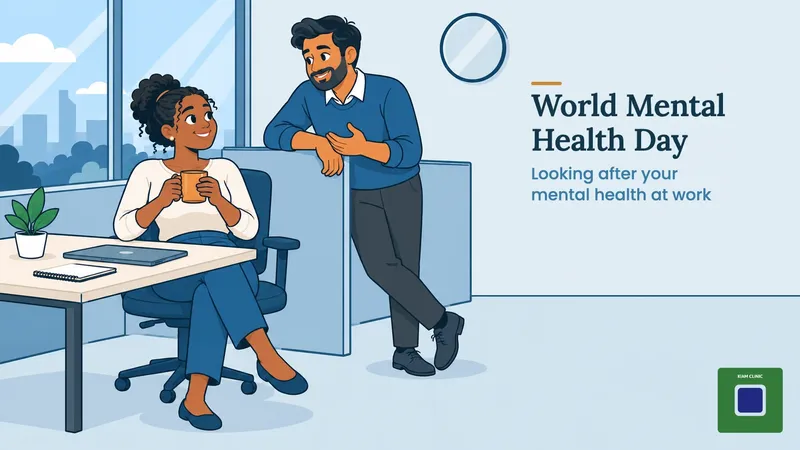
Looking after your mental health at work means noticing the early signs of strain, taking small daily steps that protect your wellbeing, and knowing what support you can ask for. World Mental Health Day falls on 10 October each year, and it is a good moment to check in with yourself.
Here is what the evidence says helps, and what to do when it feels like more than stress.
In short
- Stress at work shows up in your body, your thinking and your behaviour, often before you name it.
- Small daily habits, such as proper breaks, movement and talking to someone, protect your wellbeing.
- Your employer can adjust your workload or hours, and government support is available without a diagnosis.
- Low mood that lasts most of the day, every day, for more than two weeks is worth a professional view.
Why does work matter so much for mental health?
Because the conditions you work in affect your wellbeing, not only your attitude to them. NICE guidance on mental wellbeing at work, published in 2022, asks employers to take a preventive approach to workplace culture, workload, job quality and role autonomy, meaning how much control you have over your work.
The same guidance recognises that wellbeing at work also depends on life beyond it: physical health, relationships, home and money. If work feels harder at the moment, part of the reason may sit outside the office.
What are the early signs of stress and burnout at work?
The earliest signs are often physical and easy to miss. The NHS page on stress lists symptoms such as:
- In your body: headaches, muscle tension, stomach problems, or a faster heartbeat.
- In your thinking: difficulty concentrating, struggling to make decisions, feeling overwhelmed, constant worry, forgetfulness.
- In your behaviour: being irritable and snappy, sleeping or eating too much or too little, avoiding people, drinking or smoking more.
Burnout is what long-term stress can turn into. NHS Every Mind Matters describes it as physical, mental and emotional exhaustion after long-term or severe stress. If Sunday evenings bring dread, you feel detached from work you used to care about, and rest no longer restores you, that pattern deserves attention.
What can you do day to day?
Small, regular habits make the biggest difference. The NHS's five steps to mental wellbeing are a good framework:
- Connect. Have lunch with a colleague instead of at your desk.
- Be active. Walk at lunchtime, or do part of the commute on foot.
- Keep learning. Take on a skill or responsibility that interests you.
- Give. Ask a colleague how they are, and listen to the answer.
- Pay attention to the present. A few slow breaths between meetings counts.
For stress itself, the NHS suggests breaking big tasks into smaller chunks, planning ahead for heavy days, and setting small targets rather than trying to do everything at once. Try not to lean on alcohol or cigarettes to unwind.
What support can you ask your employer for?
More than many people realise. NICE recommends that managers have the power to adjust workload or work intensity, for example through flexible or hybrid working, and that employers consider offering an employee assistance programme (EAP), a confidential helpline and counselling service.
If you have a mental health condition, the law goes further. Under the Equality Act 2010, employers must make reasonable adjustments so that workers with physical or mental health conditions are not put at a substantial disadvantage. GOV.UK's examples include doing a task a different way, flexible hours and a phased return after time off.
There is also Access to Work, a government scheme offering support with managing your mental health at work, including a tailored plan and one-to-one sessions with a mental health professional. You do not need a diagnosis to apply, it does not affect other benefits, and the mental health support can be claimed once.
When is it more than work stress?
When low mood or loss of interest settles in and stays. The NHS advises seeing a GP if you have symptoms of depression for most of the day, every day, for more than two weeks. Its symptoms persist for weeks or months and reach into work, social and family life.
NICE's guideline on depression in adults suggests two questions a professional might ask. During the last month, have you often been bothered by feeling down, depressed or hopeless? And have you often been bothered by having little interest or pleasure in doing things? If the answer to either is yes, it is time to talk to someone.
Stress, anxiety and depression can look similar from the inside, which is why an assessment with a consultant psychiatrist looks at severity, duration, risk and what else may be going on alongside.
Frequently asked questions
Is burnout a mental health condition?
Burnout is not a diagnosis in its own right, but it is a real state of exhaustion. NHS Every Mind Matters describes it as physical, mental and emotional exhaustion that can follow long-term or severe stress. It overlaps with depression and anxiety, so if it has lasted weeks, or you feel hopeless, a GP or a psychiatrist can help.
Can I get mental health support at work without a diagnosis?
Yes. The government's Access to Work scheme offers mental health support, including a tailored plan and one-to-one sessions with a mental health professional, to people in paid work in England, Scotland or Wales. GOV.UK states that you do not need to be diagnosed with a condition to apply.
What is World Mental Health Day?
World Mental Health Day takes place every year on 10 October. It is an international day for raising awareness of mental health and for talking about it more openly, at home, in schools and at work. Many workplaces use it to start conversations about wellbeing; the support should continue all year.
When to get help
It is worth getting a professional view if:
- you have tried the steps above and things are not improving
- low mood or loss of interest has lasted most of the day, every day, for more than two weeks
- stress is affecting your sleep, relationships or work
- you are using alcohol or other substances to get through the week
The NHS advises seeing your GP if you are struggling to cope with stress. If low mood has set in, you can also book a depression assessment with Dr Abbass Mohammadinasab, our Lead Consultant Psychiatrist, online or at our Epsom clinic. Where anxiety is the louder problem, we also offer anxiety assessment and treatment. Our assessment options page explains how to book.
Looking after your mental health at work is not a one-day job, but one honest conversation this week is a good place to start.
Need help now? If you think you might act on thoughts of suicide or you are in danger, call 999 or go to A&E. For urgent mental health help, call NHS 111 and choose the mental health option. You can talk to Samaritans any time, free, on 116 123, or text SHOUT to 85258.
References
- Mental wellbeing at work (NG212), Recommendations. NICE, 2022.
- Stress. NHS, 2026.
- Dealing with stress. NHS Every Mind Matters, 2026.
- 5 steps to mental wellbeing. NHS, 2022.
- Reasonable adjustments for workers with disabilities or health conditions. GOV.UK, 2026.
- Access to Work: get support if you have a disability or health condition. GOV.UK, 2026.
- Symptoms: depression in adults. NHS, 2023.
- Depression in adults: treatment and management (NG222), Recommendations. NICE, 2022, reviewed 2026.
Useful resources
- Samaritans: free, confidential support any time, on 116 123, by phone, email or letter, for anyone who is struggling to cope.
- NHS talking therapies: free NHS therapy for stress, anxiety and depression in England. You can refer yourself without seeing a GP first.
- Your Mind Plan, NHS Every Mind Matters: five quick questions that give you a personal plan of practical tips for stress, sleep and mood.
- Access to Work mental health support: how to apply for a tailored plan and one-to-one sessions to help you stay in work.
This article is for general information. It is not a diagnosis or a substitute for advice from a qualified professional who knows your situation.