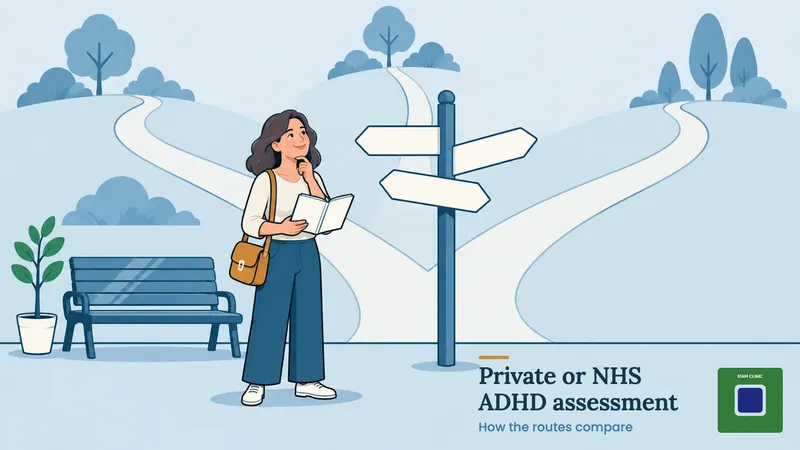
There are three main routes to an ADHD assessment in the UK: an NHS referral through your GP, the NHS Right to Choose scheme in England, and a private assessment you pay for yourself. All three should lead to the same thing: a full assessment by a specialist, following NICE guidance.
They differ in how you get there, how long you wait, what you pay and what happens afterwards. This article sets them side by side.
In short
- On every route, NICE says only a specialist should diagnose ADHD, after a full assessment.
- The NHS route starts with your GP, or a teacher for a child. It is free, and waits vary from months to years.
- In England, Right to Choose lets your GP refer you to any provider with an NHS contract for ADHD, including a private clinic, free.
- A private assessment is booked directly and paid for yourself. At Kiam Clinic, an adult assessment costs £695 online or £1,095 in person.
Who carries out the assessment, and what should it include?
The standard is the same on every route. NICE guidance says ADHD should only be diagnosed by a specialist psychiatrist, paediatrician or other appropriately qualified professional with expertise in ADHD, after a full assessment: your symptoms in different settings, your developmental and psychiatric history, reports from people who know you, and your mental state. It should not rest on questionnaires alone.
How does the NHS route work?
It is free and starts with your GP. For adults, the NHS advises seeing a GP if symptoms affect your studies, work or relationships. The GP may refer you to a mental health professional who specialises in ADHD.
For children, the NHS suggests talking to a teacher first. The teacher usually involves the school's special educational needs co-ordinator (SENCo), and a GP or the SENCo can request a referral.
NHS pages say waits run from several months to years, and the plain English summary of the NHS England ADHD Taskforce report says some people wait more than two years, and in some areas 10 to 15 years, and recommends new ways to cut waits.
What is NHS Right to Choose?
Right to Choose is an NHS route. The NHS explains that when a GP refers you, in most cases you have a legal right to choose the hospital or service, including private providers that deliver it for the NHS. For ADHD, you can ask for an NHS appointment at any clinic, including a private clinic, if it provides ADHD services for the NHS in England.
Three things to know:
- It is England only.
- It still starts with a GP referral. NHS Surrey and Sussex explains that your GP makes the referral and the provider must hold an NHS contract for that service.
- Local rules vary. ADHD UK notes that some local NHS bodies have introduced restrictions, so it depends on where you live. Your GP can tell you which are open to you.
How does a private ADHD assessment work?
You arrange and pay for a private assessment directly, with no referral needed. At Kiam Clinic you book a date rather than joining a list, and every fee is on our fees page: £695 online or £1,095 in person for adults, and £1,395 online or £1,695 in person for children and young people, with no separate administration charges.
Our assessments follow the NICE standard above: 75 to 90 minutes with a consultant psychiatrist for adults, or 90 to 120 minutes with a Consultant Child and Adolescent Psychiatrist for children, with questionnaires beforehand, a written report and a letter to your GP.
Our Lead Consultant Psychiatrist, Dr Abbass Mohammadinasab, also leads a community team in the NHS, so we understand both systems. Going private is not a comment on NHS care: you take on the cost yourself, and choose when and how you are seen.
What happens after the assessment on each route?
NICE recommends a comprehensive treatment plan for everyone diagnosed, with medication only where clinically appropriate and after baseline health checks. On the NHS route, including Right to Choose, that treatment sits within the NHS service. On the private route, follow-up and treatment are charged separately, so ask about those costs before you book.
Many people hope their GP will then take over routine prescribing, known as shared care. At Kiam Clinic, once treatment has been stable for at least four weeks, we can propose a Shared Care Agreement: your GP takes on routine prescribing while we remain responsible for specialist review, at no charge for arranging it. Some practices decline, so ask your GP early.
If you are assessed privately but later want NHS care, the Royal College of Psychiatrists says NHS adult ADHD services will first check that your report is complete, so ask your local service what it accepts before you book.
Frequently asked questions
Is a private ADHD assessment as thorough as an NHS one?
It should be, because both follow the same NICE guidance: a specialist clinician, a full history, information from people who know you, and a written report. What varies is the provider, not the route, so ask who carries out the assessment and whether a full report and GP letter are included.
Is NHS Right to Choose free?
Yes. Right to Choose is NHS-funded care, so the assessment costs you nothing. Your GP makes the referral, and the provider must hold an NHS contract for ADHD services in England. It does not apply in Scotland, Wales or Northern Ireland, and some local NHS areas have added restrictions, so ask your GP what is available.
Will the NHS accept a private ADHD diagnosis?
Often, but not automatically. The Royal College of Psychiatrists says NHS adult ADHD services check that a private report includes all the detail a thorough assessment should before accepting you. Shared care with your GP is a separate decision, and practices vary, so check with both before you commit.
When to get help
An assessment is worth seeking, by whichever route, if difficulties with attention, restlessness or impulsivity have been there since childhood, show up in more than one setting, and get in the way of work, study, home life or relationships.
If this sounds familiar, our free five-minute ADHD self-screening test is a good first step. It can't diagnose ADHD, but it can help you decide whether to book an assessment with one of our consultant psychiatrists, online or at our Epsom clinic. For a child, talk to the SENCo and your GP; our assessment is led by a Consultant Child and Adolescent Psychiatrist. When you are ready, you can compare assessment options and book.
What matters is a clear answer, and there is more than one good way to reach it.
Related reading
- Private ADHD assessment cost in the UK: what should be included? — what a private fee should cover.
- Starting ADHD medication in the UK: titration and shared care — what treatment and shared care look like after a diagnosis.
References
- Attention deficit hyperactivity disorder: diagnosis and management (NG87), recommendations. NICE, 2018, last updated 2024.
- ADHD in adults. Royal College of Psychiatrists, 2023.
- ADHD in adults. NHS, accessed October 2026.
- ADHD in children and young people. NHS, accessed October 2026.
- Plain English summary of the ADHD Taskforce report. NHS England, 2025.
- Your choices in the NHS. NHS, accessed October 2026.
- Right to Choose for mental health care. NHS Surrey and Sussex Integrated Care Board, accessed October 2026.
- Right to Choose. ADHD UK, accessed October 2026.
Useful resources
- ADHD UK — a UK charity with information, support groups and guides to the NHS, Right to Choose and private assessment routes.
- AADD-UK — a site run for and by adults with ADHD, with peer support groups across the UK.
- NHS: ADHD in adults — the NHS's own overview of symptoms, getting a diagnosis and treatment, with a separate page for children and young people.
This article is for general information. It is not a diagnosis or a substitute for advice from a qualified professional who knows your situation.