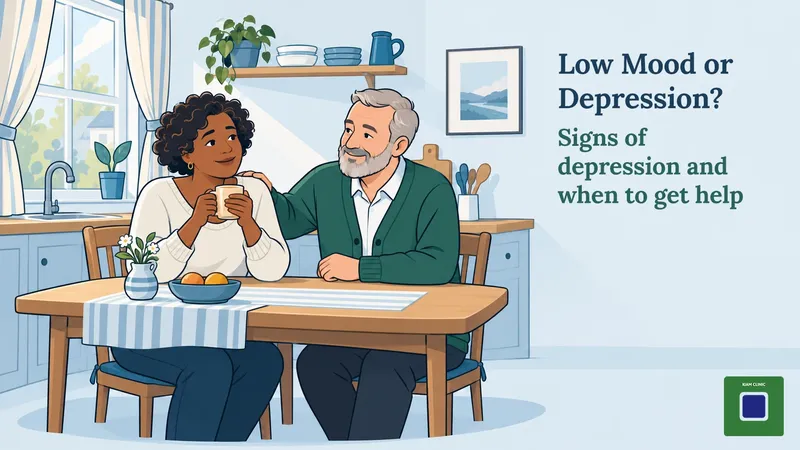
Low mood usually lifts within a few days or weeks. Depression lasts longer, fills most of your day and starts to get in the way of daily life. NHS advice on low mood and depression says a low mood that lasts longer than about two weeks may be a sign of depression.
This guide covers the signs of depression, what can help and when to speak to a professional. If you recognise yourself here, you're not alone, and depression is treatable.
In short
- Low mood usually passes within days. Depression lasts more than about two weeks, fills most of the day and affects daily life.
- Signs show up in your feelings, your body and what you do.
- Moving more, a steady sleep routine and talking to someone can help low mood lift.
- See your GP if symptoms last most of the day, every day, for more than two weeks.
- Most people with depression can recover fully with the right treatment and support.
What is the difference between low mood and depression?
The difference comes down to how long it lasts, how much of your day it fills and how much it gets in the way. NICE guidance on depression in adults judges severity in a similar way: by the symptoms, how long they last and their effect on daily life.
How long has it lasted?
The Royal College of Psychiatrists notes that ordinary low spells usually have a reason and rarely last more than a week or two. Low mood lasting longer than about two weeks may be a sign of depression.
How much of your day does it fill?
With depression, low mood or a loss of pleasure is there for most of each day, week after week. Things you normally enjoy can feel flat.
How much is it getting in the way?
Everyday low mood rarely stops you getting on with life. Depression tends to affect your work, your relationships and how you look after yourself.
Two questions a professional might ask
NICE suggests health professionals consider asking:
- Over the last month, have you often felt down, depressed or hopeless?
- Over the last month, have you often had little interest or pleasure in doing things?
A yes to either isn't a diagnosis, but it's a good reason to talk to your GP.
What are the signs of depression?
Depression can affect your mood, your body and your behaviour, as the NHS guide to depression symptoms explains. Most people notice some signs, not all.
In how you feel
- a low, sad or hopeless mood that doesn't lift
- little interest or enjoyment in things you used to like
- feeling guilty, worthless or low in confidence
- feeling tearful, irritable or anxious
- finding it hard to concentrate or make decisions
- thoughts that life isn't worth living, or of harming yourself
In your body
- tiredness and low energy
- poor sleep, waking very early or sleeping much more than usual
- eating less or more than usual, with changes in weight
- aches, pains or stomach upsets with no clear cause
- moving or speaking more slowly than usual
- a lower sex drive
Physical signs can come first. NICE notes that many people with depression first see their GP about a physical symptom.
In what you do
- seeing friends less or avoiding social plans
- dropping hobbies you used to enjoy
- struggling to keep up at work or at home
- not looking after yourself or your home as usual
Depression can creep up slowly, so a partner or friend may notice the change before you do.
What can help when your mood is low?
Small, steady steps can help a low mood lift. If you might have depression, use them alongside professional support, not instead of it.
- Do one small thing each day that matters to you or that you used to enjoy.
- Move a little every day. A short walk counts.
- Talk to someone you trust, or write down how you feel.
- Keep a steady sleep routine, going to bed and getting up at the same times.
- Go easy on alcohol. It may seem to help at first, but it makes depression worse over time.
- Try a self-help guide based on cognitive behavioural therapy (CBT), which looks at how your thoughts, feelings and actions affect each other.
If your mood hasn't lifted after about two weeks, keep going with these steps and talk to a professional too.
How is depression treated?
Depression is treatable, and the NHS overview of depression says most people with depression can make a full recovery with the right treatment and support. NICE says you should be offered a choice, including the option to say no or change your mind.
- Watchful waiting. For mild depression, your GP may suggest waiting to see if it improves, with a review after 2 to 4 weeks.
- Guided self-help. A CBT-based workbook or online course, usually over 6 to 8 sessions, with a therapist's support.
- Exercise. The NHS page on depression treatment describes exercise as one of the main treatments for mild depression.
- Talking therapies, such as CBT, counselling, interpersonal therapy (which focuses on relationships) or behavioural activation, which helps you plan activities that lift your mood.
- Medication, where clinically appropriate. NICE says it shouldn't routinely be the first treatment for milder depression, unless that's your informed choice. For more severe depression, options include talking therapy, medication or both.
At Kiam Clinic, our depression assessment and treatment is led by our Lead Consultant Psychiatrist, Dr Abbass Mohammadinasab, a senior mental health doctor. Treatment can include talking therapy with our psychotherapist.
How can you support someone who might be depressed?
Noticing, listening and staying in touch can make a real difference, even if you're not sure what to say. NHS advice on helping others suggests:
- Tell them you're worried and that you have time for them.
- Listen more than you advise. Open questions starting with "how" or "what" can help someone talk.
- Keep doing ordinary things together, like a walk or a film.
- Offer practical help, such as shopping or going with them to an appointment.
- Encourage help gently, such as seeing their GP, without forcing it.
- Look after yourself too.
If you're worried they might be thinking about suicide, ask them directly. The Royal College of Psychiatrists explains that asking won't put the idea into their head or make them more likely to act on it.
Frequently asked questions
When should you see a doctor about depression?
The NHS advises seeing a GP if you've had symptoms of depression for most of the day, every day, for more than two weeks. Go sooner if low mood is affecting your daily life or causing you distress. If you're having thoughts of harming yourself or ending your life, get help straight away.
Is it grief or depression?
Grief is a natural response to loss, and deep sadness is part of it. The NHS explains that grief usually eases with time, and that feeling hopeless or having suicidal thoughts is rare in grief.
For some people, bereavement can lead to depression, so talk to your GP if you're worried.
Is depression a sign of weakness?
No. The NHS describes depression as a real illness with real symptoms, not something you can snap out of.
It is also common. NICE estimates that about 6 in 100 adults in England have an episode of depression each year. More than 15 in 100 people have one at some point.
When to get help
It's worth getting a professional view if:
- you've had symptoms of depression for most of the day, every day, for more than two weeks
- low mood is affecting your work, relationships or daily life
- the things you've tried haven't helped
- you've also had spells of feeling unusually high or overexcited, which a doctor will want to know about
- you have thoughts of harming yourself or that life isn't worth living: get help now, using the numbers below
Your GP will ask how you've been feeling and may use a short questionnaire. There's no physical test for depression. But NHS guidance on diagnosis explains that your GP may suggest blood or urine tests to rule out other causes, such as an underactive thyroid.
In England, adults can also refer themselves to free NHS Talking Therapies without seeing a GP first.
For a specialist opinion, our depression assessment for adults is available online by video or at our clinic in Epsom, Surrey. It ends with a treatment plan agreed with you, and a written summary for you and, with your consent, your GP. You can check what an assessment costs first.
However your mood has been lately, you don't have to work out what it means on your own. If you have questions about our service, you're welcome to contact our team.
Need help now? If you think you might act on thoughts of suicide or you are in danger, call 999 or go to A&E. For urgent mental health help, call NHS 111 and choose the mental health option. You can talk to Samaritans any time, free, on 116 123, or text SHOUT to 85258.
References
- Low mood and depression. NHS Every Mind Matters, 2021, updated 2026.
- Depression in adults: treatment and management (NG222). NICE, 2022, reviewed 2026.
- Depression. Royal College of Psychiatrists, 2020.
- Depression in adults: symptoms. NHS, 2023.
- Depression in adults: overview. NHS, 2023.
- Depression in adults: treatment. NHS, 2023.
- Helping others with mental health problems. NHS Every Mind Matters, 2021, updated 2026.
- Depression in adults: diagnosis. NHS, 2023.
Useful resources
- NHS Talking Therapies: find a free NHS talking therapy service in England that you can refer yourself to.
- Every Mind Matters: self-help CBT techniques: free NHS guides, including one on building motivation and a routine when you feel low.
- Rethink Mental Illness: depression: plain-English information on depression and its treatment, for adults in England and the people who care about them.
- Samaritans: if you're worried about someone else: practical guidance on supporting someone, including someone having suicidal thoughts.
This article is for general information. It is not a diagnosis or a substitute for advice from a qualified professional who knows your situation.
Medically reviewed by [clinician name, role] on [date].