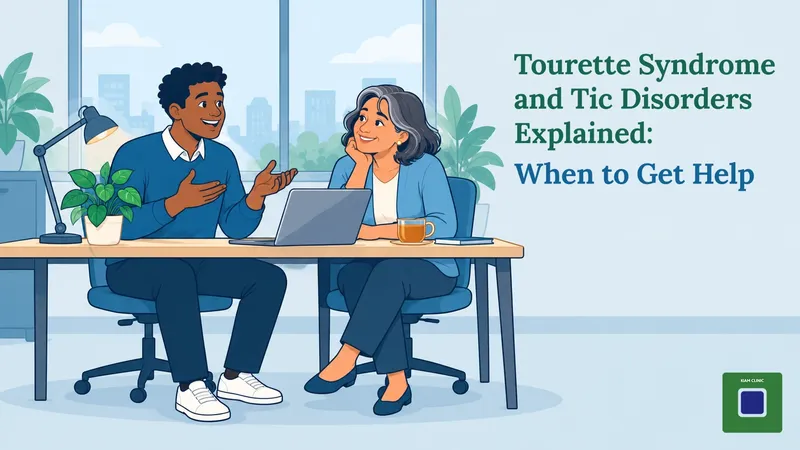
Tourette syndrome is a tic disorder where several movement tics and at least one vocal tic have lasted more than a year, starting before age 18. It's worth getting help if tics cause pain, distress or problems at work, school or home, or if new tics begin in adulthood.
Tics are sudden, repeated movements or sounds that are hard to control. Many children have tics at some point, and the NHS points out that this doesn't always mean Tourette syndrome.
In short
- Tics are sudden, repeated movements or sounds that are hard to control. They usually start in childhood.
- Tourette syndrome means several movement tics and at least one vocal tic, lasting over a year and starting before 18.
- Swearing tics are uncommon. Most people with Tourette syndrome don't have them.
- ADHD and OCD often come alongside Tourette syndrome, but not always.
- When tics cause problems, behavioural therapy is the first-choice treatment.
What are tics?
Tics are quick, repeated movements or sounds that you don't choose to make. The European clinical guidelines on tic disorders describe how they come and go, changing in strength, frequency and type.
There are two main kinds:
- Motor tics are movements, such as blinking, grimacing, jerking the head or shrugging.
- Vocal tics are sounds, such as sniffing, throat clearing, grunting, coughing or repeating a word.
Simple and complex tics
Both kinds can be simple or complex:
- Simple tics use one muscle group or make a short sound, such as a blink or a sniff.
- Complex tics involve several muscle groups, or whole words and phrases, such as touching objects or copying other people's movements.
The urge before a tic
Many people feel an uncomfortable build-up before a tic, a bit like an itch that needs scratching. Doctors call this a premonitory urge, and it eases once the tic happens.
The NHS guide to tics says tics can sometimes be partly held back, and often get worse when people focus on them. Stress, excitement and tiredness can set them off too.
Tourette syndrome or another tic disorder: what's the difference?
The difference is which kinds of tics you have, and how long they have lasted. In each case, the tics start before the age of 18 and aren't caused by drugs or another medical condition.
- Provisional tic disorder: motor tics, vocal tics or both, for less than a year. This is common in children, and often settles.
- Persistent (chronic) motor or vocal tic disorder: motor or vocal tics, but not both, for more than a year.
- Tourette syndrome: several motor tics and at least one vocal tic for more than a year, though not necessarily at the same time.
Tourettes Action describes these as one spectrum of tic disorders. The European guidelines report that Tourette syndrome affects 3 to 10 in every 1,000 people, and it is more common in boys.
A doctor diagnoses a tic disorder from your history and by seeing the tics. The European guidelines say scans and other tests don't help with this, so they're used only to rule out other conditions.
What other conditions can come with Tourette syndrome?
Many people with Tourette syndrome also have another condition, though not everyone does. The European guidelines name two as the most common:
- ADHD (attention deficit hyperactivity disorder), which affects attention, activity levels and impulse control.
- OCD (obsessive-compulsive disorder), which involves frequent unwanted thoughts and repeated actions or rituals.
Tourettes Action notes that these can be as hard to manage as the tics, or harder. In adults, quality of life is linked more to OCD and depression than to how strong the tics are, the European guidelines note. So a good assessment looks at the whole picture.
Do people with Tourette syndrome swear? Myths and facts
Most people with Tourette syndrome don't swear involuntarily, and that's not the only myth.
Myth: everyone with Tourette syndrome swears
Swearing tics, called coprolalia, are uncommon. The NHS describes them as rare, and the European guidelines put them at 15–20% of people with Tourette syndrome. Tourettes Action calls this the biggest misunderstanding about the condition.
Myth: people could stop their tics if they tried
Tics are involuntary. Many people can hold them in for a while, say in a meeting, but it takes effort and the urge keeps building. That's also why tics can seem to vanish during a doctor's appointment.
How are tic disorders treated?
Not everyone with tics needs treatment, and any treatment starts with clear information. The European guidelines on psychological treatment recommend psychoeducation (practical information about the condition) for everyone diagnosed. If tics aren't causing problems, watching and waiting can be enough.
Everyday steps
The NHS suggests a regular routine with plenty of physical activity, a calm bedtime routine and avoiding stress where you can.
Behavioural therapy
When information alone isn't enough, behavioural therapy is the first-choice treatment for children and adults:
- Habit reversal training teaches you to notice the urge, then use a deliberate "competing" movement that makes the tic hard to do.
- Comprehensive behavioural intervention for tics (CBIT) builds on habit reversal, adding relaxation and work on the situations that set tics off.
- Exposure and response prevention (ERP) helps you get used to the urge without doing the tic.
These therapies take regular practice. They usually reduce tics rather than stopping them completely.
Medication, where clinically appropriate
Medication may be considered if behavioural therapy hasn't helped, or alongside it. The NHS notes that the choice depends partly on whether you also have ADHD or OCD, and that your doctor should explain possible side effects. Sometimes the condition alongside the tics is the one to treat first.
At Kiam Clinic, our adult tic and Tourette service covers both assessment and management.
Frequently asked questions
Can tics start in adulthood?
Yes, but it's unusual: the NHS says tics only very occasionally start in adulthood. New tics in an adult can have another cause, such as a health condition or some illegal drugs.
A specialist will also consider functional tic-like movements, which can look similar but are a different condition. So new adult tics are worth checking.
Can you have Tourette syndrome without vocal tics?
No. Tourette syndrome needs at least one vocal tic as well as several motor tics. Motor tics alone for over a year usually means persistent (chronic) motor tic disorder.
But vocal tics can be as small as a sniff or a throat clear, so they are easy to miss or mistake for an allergy.
Do tics go away with age?
Often they improve. Tics tend to be strongest between about 8 and 12, and usually ease during the teenage years.
By 18, most people are no longer held back by them, though many still have mild tics. For some adults, tics carry on, and they can flare up with stress or tiredness.
Can adults be diagnosed with Tourette syndrome?
Yes. The tics must have started before the age of 18, but the diagnosis can be made at any age.
Tourette syndrome is often recognised late, and many people are diagnosed years after their tics began. A diagnosis can help you make sense of your tics and find the right support.
When to get help
The NHS suggests getting advice if your tics:
- happen very often, or are becoming more frequent or severe;
- cause pain, discomfort or injury;
- lead to embarrassment, bullying or feeling cut off from others;
- get in the way of work, study or everyday life;
- come with anger, low mood or self-harm.
New tics in adulthood are also worth checking, as they can have other causes.
For adults
You can talk to your GP. You can also see Dr Saidi, who leads the clinic's tic and Tourette assessments, online across the UK or in person at our Epsom clinic.
The appointment lasts 75 to 90 minutes. Dr Saidi takes a full history, looks at your tics and anything alongside them, such as ADHD, and explains what he finds. You'll receive a diagnostic opinion where appropriate, a written report and a plan.
You can see what the assessment costs or choose and book an appointment.
Tourettes Action suggests keeping a simple tic diary and, if you can, a short video from home. Tics often quieten during appointments, so a video can show what the doctor might not see. Try not to draw attention to the tics while filming.
For children and teenagers
If you're worried about your child's tics, start with your GP, who can refer them to a specialist such as a paediatrician. Tourettes Action also supports families. Our tic and Tourette service is for adults.
Tics can be tiring to live with and hard to explain, at any age. Clear information and the right support, from your GP, Tourettes Action or a specialist, can make everyday life easier.
Need help now? If you think you might act on thoughts of suicide or you are in danger, call 999 or go to A&E. For urgent mental health help, call NHS 111 and choose the mental health option. You can talk to Samaritans any time, free, on 116 123, or text SHOUT to 85258.
Related reading
- What happens in an ADHD assessment: ADHD often comes alongside tics, and this article explains what an adult ADHD assessment involves.
References
- Tourette syndrome. NHS, 2025.
- European clinical guidelines for Tourette syndrome and other tic disorders, version 2.0. Part I: assessment. European Society for the Study of Tourette Syndrome (ESSTS), European Child & Adolescent Psychiatry, 2022.
- Tics. NHS, 2023.
- What is TS? Tourettes Action, 2026.
- Co-occurring symptoms. Tourettes Action, 2026.
- European clinical guidelines for Tourette syndrome and other tic disorders, version 2.0. Part II: psychological interventions. European Society for the Study of Tourette Syndrome (ESSTS), European Child & Adolescent Psychiatry, 2022.
- Getting diagnosed. Tourettes Action, 2026.
Useful resources
- Tourettes Action Helpdesk: confidential support by live chat, contact form or email for people with Tourette syndrome, their families, teachers and employers.
- Tourettes Action online support groups: regular video groups for adults with Tourette syndrome, and for parents and families, in the UK.
- Support in everyday life: Tourettes Action's information for adults on work, benefits, study, housing and travel.
- Support in school: Tourettes Action's steps for parents working with a child's school or college.
This article is for general information. It is not a diagnosis or a substitute for advice from a qualified professional who knows your situation.