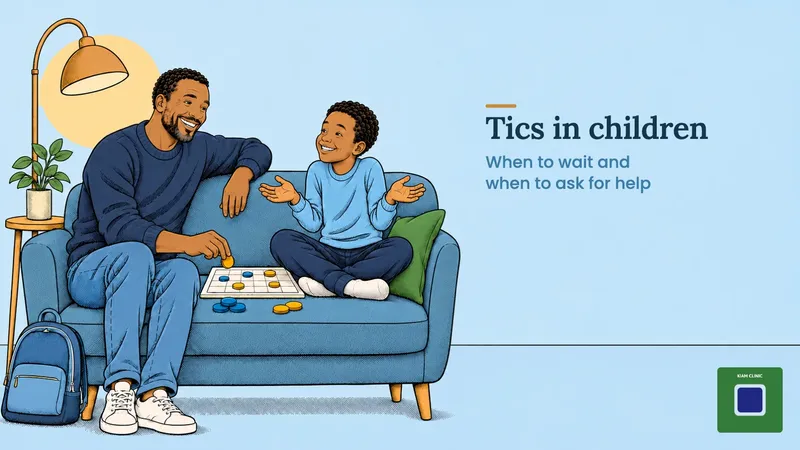
Tics in children are common, usually mild, and often ease by the late teens, so calmly watching and waiting is often the right first step. It is worth seeing your GP if your child's tics are very frequent, getting worse, painful, or affecting their mood, friendships or school life.
Tics are quick, repeated movements or sounds that are hard to control, such as blinking, shrugging, sniffing or throat clearing. Seeing them for the first time can be worrying.
In short
- Tics often start around age 5 and are usually most noticeable between about 8 and 12.
- Many children's tics ease a lot during the teenage years.
- Mild tics usually need no treatment; try not to focus on them.
- See your GP if tics are frequent, painful, getting worse or affecting daily life.
How common are tics in children?
Tics are fairly common in childhood. The NHS guide to tics says they usually first appear around age 5, are most noticeable from about 8 into the teenage years, and often improve after puberty.
Some tics last only a few months; others come and go over several years. The European clinical guidelines on tic disorders describe tics as "waxing and waning": they change in how often they happen, how strong they are and which tics appear. The same guidelines say tics are at their worst between 8 and 12 for most children, and often ease a lot in adolescence.
What can make tics worse?
The exact cause of tics is not known, but they often run in families.
The NHS says some things can make tics worse:
- stress or anxiety;
- tiredness;
- excitement, such as birthdays, holidays or a big match.
Many children can hold back a tic for a short time, for example in class, but this takes effort and often brings inner tension. So tics may seem worse when your child gets home and relaxes. It does not mean they are doing it on purpose.
When is it fine to wait and watch?
The NHS says mild tics usually don't need treatment. The European guidelines on psychological treatments for tics say a "watch and wait" approach can be reasonable when tics are not causing difficulties, as many young people's tics lessen naturally over time.
How you can help at home
- Try not to comment on the tics. The NHS says focusing on or talking about tics can make them worse.
- Look after sleep. A calm, regular bedtime routine, with phones and screens put away before bed, can help.
- Keep days predictable. A steady routine with plenty of physical activity is suggested by the NHS.
- Explain tics simply. European guidelines recommend learning about tics as the first step for every family.
When should you ask for help?
You don't always need to see a GP about mild tics. The NHS suggests seeing one if your child's tics:
- happen very often, or are becoming more frequent or severe;
- cause emotional or social problems, such as embarrassment, teasing or isolation;
- cause pain or injury, for example from a strong neck movement;
- get in the way of school or daily life;
- come with anger, low mood or self-harm.
The NHS also says tics often occur alongside ADHD or obsessive compulsive disorder (OCD).
What happens when you see the GP?
The GP will ask about the tics and how they affect your child. A short video of the tic can help, but the NHS advises not drawing attention to it while filming.
The GP may refer your child to a paediatrician or a specialist. According to the NHS page on Tourette syndrome, Tourette syndrome may be considered if tics started before 18, have lasted a year or more, and include both movements and sounds.
Scans and brain tests are not usually needed to diagnose a tic disorder. The European guidelines say they should be done only if there is a clinical reason.
If tics are causing real problems, behavioural therapies such as habit reversal therapy or comprehensive behavioural intervention for tics (CBIT) are recommended first. These teach children practical ways to manage the urge to tic.
Frequently asked questions
Will my child grow out of their tics?
Many children's tics ease a great deal as they grow up. European guidelines say that up to 80% of children whose tics began before age 10 see a significant decrease during adolescence, and by 18 most no longer have significant problems from them. Some people keep mild tics into adulthood.
Should I ask my child to stop their tics?
It is usually better not to. The NHS says focusing on or talking about tics can make them worse. Holding back tics takes effort and can leave a child tense, so constant reminders can add stress. Instead, keep things calm, look after sleep and routines, and talk to your GP if the tics are causing your child problems.
Do tics in children mean Tourette syndrome?
Not necessarily. Many children have tics that last only a few months. The NHS says Tourette syndrome may be considered when tics began before 18, have lasted at least a year, and include both movements and sounds. Only a doctor can make that diagnosis, so talk to your GP if you are unsure about your child's tics.
How can my child's school help?
Tourettes Action suggests meeting the school to agree how to support your child together. Keep in touch with the class teacher and the special educational needs coordinator (SENCo), and discuss what adjustments might help during the day. Some families also decide, with their child, whether to explain tics to the class to reduce misunderstanding or teasing.
When to get help
Talk to your GP if your child's tics are frequent, painful, getting worse, or affecting their mood, schoolwork or friendships. Mention any anxiety, low mood, attention difficulties or repetitive worries too. The charity Tourettes Action has a helpdesk and advice on education.
At Kiam Clinic, our tic and Tourette assessment, led by Consultant Neuropsychiatrist Dr Mohammad Saidi, is for adults, so for a child the GP is the right place to start. If attention or restlessness is the bigger worry, we offer a child ADHD assessment with a Consultant Child and Adolescent Psychiatrist, online or in Epsom.
Many childhood tics ease with time, and staying calm and patient is one of the most helpful things you can do.
Need help now? If you think you might act on thoughts of suicide or you are in danger, call 999 or go to A&E. For urgent mental health help, call NHS 111 and choose the mental health option. You can talk to Samaritans any time, free, on 116 123, or text SHOUT to 85258.
Related reading
- Tourette syndrome and tic disorders explained: when to get help: what Tourette syndrome is, the myths, and the treatments.
References
- Tics. NHS, 2023.
- European clinical guidelines for Tourette syndrome and other tic disorders, version 2.0. Part I: assessment. Szejko N et al. (ESSTS), European Child & Adolescent Psychiatry, 2022.
- European clinical guidelines for Tourette syndrome and other tic disorders, version 2.0. Part II: psychological interventions. Andrén P et al. (ESSTS), European Child & Adolescent Psychiatry, 2022.
- Tourette syndrome. NHS, 2025.
- Education: information for parent/carers and students. Tourettes Action, undated (accessed 2026).
Useful resources
- Tourettes Action Helpdesk: confidential support for people with tics, their families and schools, by live chat, form or email.
- YoungMinds Parents Helpline: free advice for parents worried about a child's mental health or wellbeing.
- NHS: Tics: plain-English guidance on tics, self-help and when to see a GP.
This article is for general information. It is not a diagnosis or a substitute for advice from a qualified professional who knows your situation.