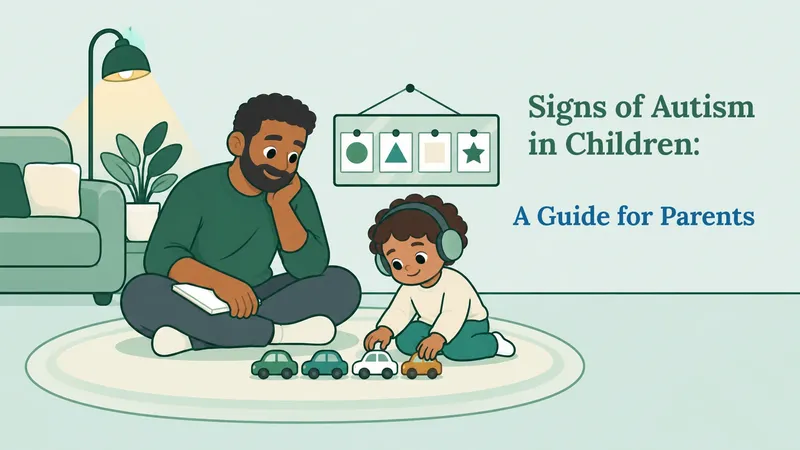
Signs of autism in children usually show up in three areas: communicating with others, behaviour and interests, and the senses. For example, a child might talk later, need strict routines, or find noise and certain clothes hard to bear. As the NHS explains, every autistic child is different, and many won't show every sign.
Signs can appear in toddlers, or not stand out until school or the teenage years. No single sign means a child is autistic. What matters is a pattern that shows up in more than one place, lasts over time and affects daily life.
If something about your child's development worries you, it's worth raising. NICE, the National Institute for Health and Care Excellence, publishes guidance on recognising autism. It tells professionals to always take parents' concerns seriously, even when others don't share them.
In short
- Signs fall into three areas: communication, behaviour and interests, and the senses.
- They can look different in toddlers, primary school children and teenagers.
- Autism can be harder to spot in girls, and in children who mask (hide) their differences.
- If your child loses words or skills, talk to your GP or health visitor promptly.
- Your GP, health visitor or your child's SENCo (special educational needs coordinator) is a good first conversation.
What are the main signs of autism in children?
The main signs are differences in how a child communicates, behaves and plays, and responds to their senses.
- Communicating and connecting: talking later, repeating words or phrases, and using less eye contact, gesture and facial expression. Two-way conversation and joining in play can be hard.
- Behaviour and interests: needing routines and getting very upset when they change. Many have very strong interests, or repeated movements such as rocking or hand-flapping (stimming).
- The senses: reacting very strongly, or hardly at all, to noise, light, smells, tastes or textures, or eating only a few foods.
Some signs are also strengths. The National Autistic Society lists being direct and honest, with a strong sense of right and wrong, among common signs. It adds that many autistic people find their interests and repeated movements calming.
Every autistic child has their own strengths and challenges, and some need much more support than others.
What are the early signs of autism in toddlers?
In toddlers and preschool children, early signs of autism often involve talking, responding to people and play. NICE and the NHS describe signs such as:
- Talking: speaking later than other children, or repeating words and phrases rather than using them to chat. This repeating is called echolalia.
- Responding: not turning when you call their name, even though their hearing is fine, or not smiling back at you.
- Sharing: rarely pointing to show you things, or not looking where you point.
- Play: playing alone, doing little pretend play, or repeating one action, such as opening and closing a door.
- Food: strong reactions to the taste, smell or texture of food.
NICE's example of a language delay is fewer than ten words by the age of 2. On its own, a delay like this can have many causes.
What can autism look like at primary school?
At primary school, signs often show up in conversation, friendships and coping with change.
- Conversation: talking at length about a favourite topic, or talking "at" people rather than with them.
- Understanding others: taking words literally and missing sarcasm.
- Play and rules: playing alone, or expecting other children to follow the rules of a game exactly.
- Change: needing things to be "just right", and becoming very distressed when plans change.
- An uneven profile: being ahead in reading or a favourite subject, while finding social or coordination skills harder.
Some children hold things together at school, then let the stress out at home, so teachers and parents may see quite different sides of them.
How can autism show up in teenagers?
In teenagers, signs are often most visible in friendships and in coping with change, such as the move to secondary school.
- Friendships: having few close friends, or wanting friends but finding them hard to keep. Some get on more easily with adults or younger children.
- Communication: speaking in a formal way, or saying things that sound blunt or rude without meaning to.
- Rules and fairness: a strong sense of fairness that can lead to arguments.
- Routines and interests: very specific interests, and routines or rituals that get in the way of daily life.
NICE notes that coping strategies or a supportive setting can hide signs until a child is older. Autistic young people are also more likely to have anxiety or depression, so it's worth keeping an eye on mood too.
Why can autism be harder to spot in girls?
NICE says autism may be under-recognised in girls, and the NHS gives masking as one reason. Masking means hiding signs of autism to fit in, and it can be exhausting.
The NHS and the National Autistic Society describe how some autistic girls may:
- copy how other children behave and play
- stay quiet in situations they find hard
- seem to cope socially, sometimes within a group of friends
- show fewer repetitive behaviours than autistic boys
- have interests that look typical, such as reading, but are unusually intense
These are patterns, not a checklist. Boys can mask too, and every child is different.
Could a child's symptoms be something other than autism?
Sometimes. Single signs can have other explanations, so no list can tell you whether a child is autistic.
For example, not responding to a name can be linked to hearing, and late talking to a speech and language delay. NICE also asks professionals to consider conditions such as ADHD (attention deficit hyperactivity disorder) and anxiety, which can occur alongside autism too.
Frequently asked questions
Can a child who makes eye contact be autistic?
Yes. NICE guidance says autism should not be ruled out because a child makes good eye contact, smiles or shows affection to family. The same goes for pretend play, or reaching early language milestones on time.
Some autistic children make eye contact even though it feels uncomfortable. What matters is the overall pattern.
At what age can autism be diagnosed?
There is no set age. Signs may be noticed very young or much later, and NICE's guidance covers children and young people up to 19.
Diagnosis can be less certain under the age of 2, so a very young child may be seen again when older. Some children are not identified until their teens.
Can an online test tell me if my child is autistic?
No. Questionnaires can help you organise what you have noticed, but NICE says screening tools should not be used to make or rule out a diagnosis.
A high score can have other causes, and a low score does not rule autism out. The National Autistic Society says only an assessment can tell you reliably.
Do children grow out of autism?
No. Autism is lifelong, and it is not an illness: it is a difference in how the brain develops.
What can change is how visible the signs are, and how much support a child needs. Understanding your child's needs helps the people around them make the right adjustments.
When to get help
It's worth getting a professional view if:
- signs have lasted a while and show up at home and at nursery or school
- they affect your child's learning, friendships or wellbeing, or family life
- you are worried, even if other people aren't
- your child loses skills, such as words, social skills or physical skills. Tell your GP or health visitor promptly: NICE says this should lead to a referral.
Next steps:
- Write down what you notice, with examples from home and school. The National Autistic Society says a list of signs may help when you talk to your GP.
- Talk to your GP or health visitor. On the NHS, a GP can often refer a child to a local autism team. The school or a health visitor may make the referral instead.
- Talk to your child's SENCo about support at school or nursery.
NHS assessments can take a few months or longer once a referral is accepted. Your GP or school can tell you what support is available while you wait.
You can also choose a private assessment. Our autism assessment for children and young people has two stages.
The first is a detailed conversation about your child's development, online or in person. The second is an observation of how your child communicates, interacts and plays, at our Epsom clinic.
Dr Hadi Shaker Naeeni, a Consultant Child and Adolescent Psychiatrist, carries out the assessment. You receive a written report to share with school and your GP, and our fees page shows what each stage costs.
You know your child better than anyone, and noticing these signs is a caring first step, not a label. If you would like a clearer picture, your GP, your child's SENCo or our two-stage autism assessment can help.
Need help now? If you think you might act on thoughts of suicide or you are in danger, call 999 or go to A&E. For urgent mental health help, call NHS 111 and choose the mental health option. You can talk to Samaritans any time, free, on 116 123, or text SHOUT to 85258.
References
- Signs of autism in children. NHS, 2026 (page last reviewed 6 May 2026).
- Autism spectrum disorder in under 19s: recognition, referral and diagnosis (CG128). NICE, 2011, updated 2017.
- Signs that a child or adult may be autistic. National Autistic Society, undated (accessed 26 September 2026).
- Supporting an autistic child. NHS, 2026 (page last reviewed 6 May 2026).
- What is autism? NHS, 2026 (page last reviewed 6 May 2026).
- Autistic women and girls. National Autistic Society, undated (accessed 26 September 2026).
- Autism assessments. NHS, 2026 (page last reviewed 6 May 2026).
- What is autism? National Autistic Society, undated (accessed 26 September 2026).
Useful resources
- National Autistic Society: help and support. Local branches, an online community and a Parent to Parent emotional support service for families.
- NHS: help and support for autistic people and their families. Where to find local and national support, including charities for parents and carers.
- GOV.UK: children with special educational needs and disabilities (SEND). How SEN support and education, health and care plans work in England, and who to talk to at school.
This article is for general information. It is not a diagnosis or a substitute for advice from a qualified professional who knows your situation.